

 English
 русский
 Español
 Français
 Português
 عربى




+86-13588556918
Content
- 1 What Is Bulk Handling Material and Why Does It Matter?
- 2 Bulk Handling Equipment: A Practical Classification
- 3 The Unloading Stage: Why Truck Dumpers Are Central to Bulk Handling Operations
- 4 Container Loading and Unloading in Bulk Material Supply Chains
- 5 How to Choose the Right Bulk Material Handling System: Selection Criteria
- 6 Comparing Common Bulk Handling Equipment Configurations
- 7 Visual Insight: Unloading Method Adoption Patterns
- 8 Maintenance and Safety in Bulk Material Handling
- 9 Frequently Asked Questions About Bulk Handling Material
- 9.1 What is bulk handling material?
- 9.2 How does a bulk material handling system work?
- 9.3 Which bulk material handling equipment is best for dusty products?
- 9.4 Can a truck dumper handle different bulk materials?
- 9.5 What is the difference between a pitless and a shallow foundation truck dumper?
- 9.6 How do unattended truck dumpers improve accuracy?
- 10 Related Resources and Next Steps
Every bulk handling material decision starts at the delivery point. When a 40-ton truck pulls into a cement plant, grain elevator, or chemical warehouse, the time it spends at the receiving dock sets the rhythm for the rest of the shift. Backhoe unloading can take 60 to 90 minutes and exposes an operator to dust, noise, and moving equipment. A well-designed bulk material handling system cuts that cycle to 10 to 15 minutes while improving safety and accuracy. This is why plant managers, maintenance leaders, and procurement teams spend so much time reviewing truck dumper specifications, container tilter options, and conveyor integration plans before buying equipment.
Bulk handling material covers everything from mined ore, coal, and sand to grain, flour, sugar, cement, plastic pellets, wood chips, and chemical powders. These materials are measured in tons rather than pieces, and their flow behavior changes with moisture, particle size, angle of repose, and dust generation. A system that works for free-flowing corn may struggle with sticky clay or aerated cement powder. For a bulk material handling equipment manufacturer, the goal is to make the transfer predictable: truck to hopper, hopper to conveyor, conveyor to storage, storage to rail or vessel, and back to process.
The practical impact of a good bulk handling material strategy goes beyond unloading speed. It reduces labor cost, shortens truck turnaround, lowers the risk of cross-contamination, improves dust control, and protects the integrity of the material. It also reduces the number of handling points where spillage, degradation, or safety incidents can occur. For processors that receive raw ingredients in large volumes, the difference between an optimized receiving station and an improvised one can represent thousands of dollars per week in operating cost.
This article explains what bulk handling material means for plant operators, which equipment is needed at each stage, how to choose between configurations, and why truck dumpers and container handling machines deserve special attention. It also includes practical maintenance guidelines, a visual comparison of typical unloading methods, and answers to common questions. The emphasis is on real-world selection because the right system should fit the material, the site, and the throughput.
What Is Bulk Handling Material and Why Does It Matter?
Bulk handling material is a broad category, but the concept is simple: any loose, granular, powdery, or lumpy product that is moved, stored, and processed in large volumes. Examples include iron ore, limestone, clinker, cement, fly ash, gypsum, coal, petcoke, cereals, oilseeds, flour, sugar, salt, starch, wood pellets, biomass, plastic granules, and compound fertilizer. The common denominator is that the material is not packaged into discrete units at the point of delivery. It arrives in bulk form, and the operation must manage it without losing flow, containment, or quality.
The broader material handling classification divides into bulk and non-bulk. Non-bulk handling usually involves individual loads such as cartons, pallets, drums, or coils, where unit integrity is the main concern. Bulk handling is different because the product can deform, segregate, bridge, clog, or become airborne. A robust bulk material handling system therefore has to control each of these risks while still moving thousands of tons per day.
From a plant perspective, bulk handling material management splits into four stages: receiving, storage, in-plant transfer, and outbound loading. Receiving is where the truck dumper sits. Storage uses silos, bins, stockpiles, or flat warehouses. Transfer uses belt conveyors, screw conveyors, chain conveyors, bucket elevators, and pneumatic pipe lines. Outbound loading uses load-out spouts, railcar loaders, or container loaders. The stage with the highest labor and safety exposure is almost always receiving, because the vehicle is large, the material is dense, and the operator must align the truck with the receiving pit before any flow starts.
| Bulk handling material | Typical industry | Handling concern |
|---|---|---|
| Cement and fly ash | Construction, power | Dust, aeration, flow collapse |
| Corn, wheat, soybeans | Agriculture, food | Moisture, spoilage, pest control |
| Wood chips and pellets | Bioenergy, pulp | Interlocking particles, dust, blockages |
| Plastic granules | Chemical, polymer | Static charge, contamination, pellet damage |
| Clinker and slag | Cement, steel | Abrasion, high temperature, dust |
Key takeaway: The core rule for bulk handling material is that flow must be engineered, not left to chance, because every pile, pocket, and transfer point can create a bottleneck or a safety exposure.
Bulk Handling Equipment: A Practical Classification
When buyers search for bulk material handling systems, they often expect a single machine to solve the entire problem. In practice, the system is a chain of machines that receive, convey, store, dose, and load material. Each link must be matched to the material and the plant layout. A belt conveyor designed for grain will not perform well with abrasive clinker if the belt speed, idler spacing, and loading point are not adjusted. Similarly, a screw conveyor that handles plastic granules smoothly can compress and overheat flour if the pitch and speed are wrong.
The equipment classification below reflects how a bulk material handling equipment supplier usually divides the scope. Receiving equipment deals with vehicles. Conveying equipment moves material continuously. Storage equipment creates buffer capacity. Dosing equipment controls the discharge rate. Dust control and safety equipment protect people and machinery. Defining the boundaries of each stage is important because it helps a customer compare proposals on an equal basis.
| System stage | Typical equipment | Primary function |
|---|---|---|
| Receiving | Truck dumpers, pit hoppers, grizzly screens | Accept material from road or rail vehicles with minimal manual labor |
| Conveying | Belt, screw, chain, bucket elevator, pneumatic pipe | Move material continuously to storage or process lines |
| Storage | Silos, bins, stockpiles, reclaim tunnels | Buffer supply between incoming vehicles and downstream demand |
| Dosing and weighing | Belt scale, screw feeder, loss-in-weight feeder | Control discharge rate and batch accuracy |
| Dust control | Bag filter, cartridge collector, transfer point enclosure | Prevent fugitive dust and protect people and equipment |
Most bulk material handling systems are procured through an equipment manufacturer or a system integrator. A bulk handling equipment wholesaler can supply individual components, but a manufacturer that also designs the unloading interface is more likely to deliver a complete receiving station. This matters because the connection between a truck dumper and a downstream conveyor is often where spills, blockages, and dust problems begin.
Key takeaway: Treat every piece of bulk handling material equipment as part of one system; the material path from truck to storage should be designed as a single continuous flow.
The Unloading Stage: Why Truck Dumpers Are Central to Bulk Handling Operations
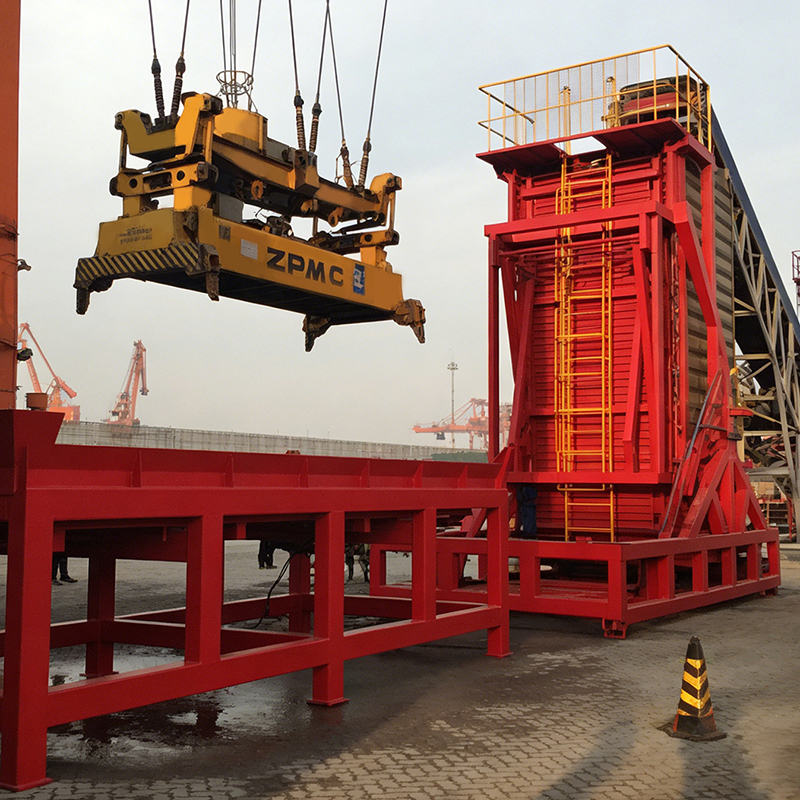
Truck dumpers are the workhorse of bulk handling material receiving stations. A truck dumper is a hydraulic platform that supports a heavy-duty vehicle and tilts it to a controlled angle, typically between 30 and 55 degrees, so the cargo flows out through the rear or side tailgate. Because the entire vehicle is lifted, the material discharges quickly and cleanly into a receiving hopper without requiring a shovel operator inside the trailer. This direct transfer reduces cycle time, cuts labor cost, and removes the most repetitive and dangerous part of manual unloading.
Rear-discharge dumpers suit grain, aggregates, and many minerals. Side-discharge models, often called sideturn truck dumpers, are preferred when the site has a long straight discharge path or when the receiving hopper is located beside the platform. A sideturn dumper lifts and tilts the vehicle to one side, which can be useful when ceiling height is limited inside a building or when the receiving pit works better beside the drive lane. Both styles serve the same purpose: convert an inefficient unloading task into a controlled gravity flow.
Plant owners compare at least five configurations when purchasing a truck dumper. The choice depends on available foundation depth, dust sensitivity, operational flexibility, and automation level. The cards below summarize the typical differences.
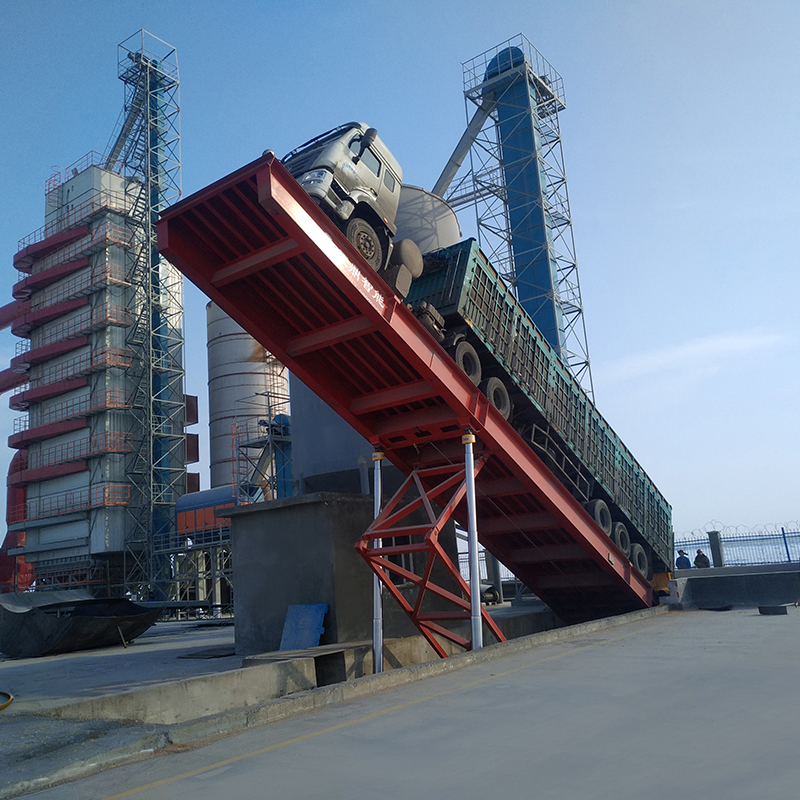 Truck DumpersWhile traditional truck dumpers synchronize side cylinders by controlling oil flow—a method prone to high failure rates and low precision—our system utilizes a mechani...View Product →
Pitless model
No deep excavation.
The platform stays
close to grade, which
reduces civil engineering
cost and works where
groundwater is high.
Shallow foundation
Requires less pit depth
than a standard dumper.
Useful for retrofit projects
with rock, water table,
or nearby structures.
Mobile dumper
Can be moved between
receiving points or plants.
Good for seasonal
operations that need
one machine in multiple
locations.
Enclosed with dust control
Shields the unloading
area and captures fugitive
dust. Recommended for
cement, lime, fly ash, and
fine chemical powders.
Unattended with weighing
Integrates vehicle recognition,
automatic restraints,
weighing,
and reporting.
Reduces labor and
improves inventory accuracy.
Modern unmanned truck dumpers use vehicle recognition, automatic restraint, sensors, and a centralized control platform. The driver remains out of the vehicle, and the system handles weighing, tilting, and reporting. This reduces labor and eliminates manual paperwork. With integrated weighing, the receiving station can record gross weight, tare weight, net weight, and compare the measured tonnage with the bill of lading. That data becomes a useful check against supplier invoices and internal loss calculations.
Key takeaway: The truck dumper is the highest-impact machine in most bulk handling material systems because it shortens vehicle turnaround, improves weight accuracy, and removes the main safety hazard of manual unloading.
Container Loading and Unloading in Bulk Material Supply Chains
Bulk materials increasingly travel in 20-foot and 40-foot containers. Cereals, oilseeds, animal feed, polymer pellets, mineral concentrates, and many food ingredients move from one country to another in bulk through container logistics. Manual unloading from a container is slow, dusty, and hazardous because workers have to rake or shovel material from the back toward the opening while standing on an unstable pile. This is not an acceptable solution for a modern bulk material handling system.
A container flipping machine grips the container, lifts it, and rotates it until the opening points downward. The entire volume discharges into a receiving hopper in a controlled cycle. This approach suits bulk solids that flow freely or with light assistance from a vibrator. It is especially effective when the container arrives on a chassis or is placed on a designated unloading pad. For facilities that handle dozens of containers per day, the cycle time is predictable and operator exposure is low.
Container loaders are the mirror image of unloaders. They fill a container through an overhead spout or loading head while a weighing and dust collection system monitors the process. A well-designed loader distributes material evenly to prevent shifting during transport. Continuous container handling systems go one step further by combining conveying, weighing, positioning, and filling into one automated station. A gantry container tilter is another compact option for low-headroom warehouses where a vertical flipping frame will not fit.
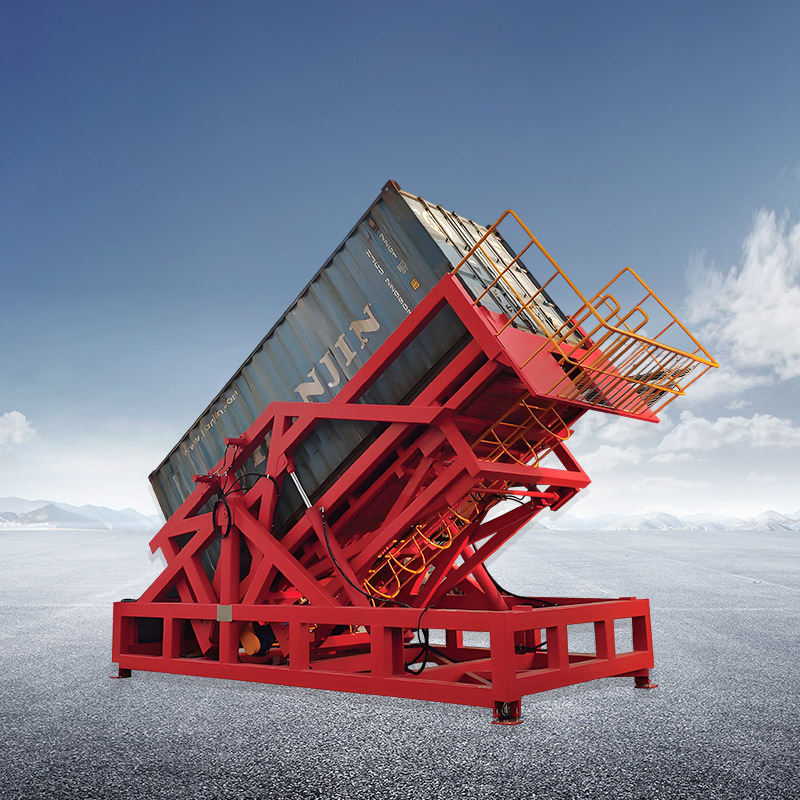 Container Flipping MachineThis equipment is a high-efficiency logistics apparatus specifically designed and manufactured for the automated loading and unloading of bulk materials in containers....View Product →
| Operation | Recommended equipment | Main advantage |
|---|---|---|
| Emptying bulk containers | Container flipping machine | High tilt angle, short cycle |
| Filling bulk containers | Container loader or spout | Uniform load, less shifting |
| High-volume continuous flow | Continuous container handling system | Lower labor, faster turnaround |
| Low-headroom warehouse | Gantry container tilter | Compact footprint, accurate positioning |
When bulk handling material arrives in containers, the principle is the same as with trucks: avoid shoveling by using gravity and controlled tilt. The decision to invest in a container flipper depends on container volume, available headroom, and how often the operation is blocked by slow unloading. A manufacturer with experience in both truck dumpers and container handling can offer a better integrated receiving layout, because both machines often connect to the same hopper and conveyor system.
Key takeaway: Containerized bulk material handling needs its own unloading strategy; a container flipping machine can match the productivity of a truck dumper and should be designed with the same dust and weighing controls.
How to Choose the Right Bulk Material Handling System: Selection Criteria
Choose a bulk handling material system based on throughput, material properties, site constraints, and automation, not on equipment price alone. Many plants discover that the cheapest unloading machine creates expensive bottlenecks because the platform capacity, pit size, or conveyor rate does not match the worst day of the week. Start by defining the realistic peak, not the average. If a plant receives 15 trucks on a normal day and 25 after a harvest or production campaign, the system should be designed for 25.
Material properties determine the mechanical design of hoppers, chutes, conveyors, and dust control. Particle size affects the opening size and the clearance between moving parts. Moisture content changes the risk of clogging and corrosion. Abrasiveness affects the hardness of the lining material. Dustiness determines whether the unloading area needs an enclosed dumper and high-efficiency filtration. Temperature matters for materials such as hot clinker or hot asphalt, which require heat-resistant components.
| Factor | What to check | Impact |
|---|---|---|
| Throughput | Trucks per day, tons per hour, peak season | Determines platform size, tilt speed, and pit capacity |
| Material property | Particle size, moisture, dustiness, abrasiveness | Affects construction materials, seals, and dust control |
| Site geometry | Foundation depth, building height, access road | Selects pitless, shallow foundation, or mobile unit |
| Automation | Weighing, PLC, remote monitoring, driver identification | Lowers labor cost and improves traceability |
| Lifecycle cost | Installation, energy, maintenance, spare parts | Prevents a low purchase price from becoming a high operating cost |
Retrofit projectExisting concrete, underground pipes, and structural steel often limit the available pit depth. A shallow foundation or pitless truck dumper reduces excavation. The receiving hopper may need to connect to a conveyor that was not designed for the new throughput, so the engineer must check the belt width, speed, and motor capacity before finalizing the unloading schedule. |
Greenfield projectA new plant can allow a standard pit dumper with a deep receiving hopper and a straight conveyor layout. Civil work is planned together with the equipment footprint. This gives more freedom to choose a fully enclosed, unattended system with integrated weighing, dust collection, and automatic driver guidance. |
Work with a bulk material handling systems supplier that can show installation examples and provide service support. A wholesaler can supply components, but a manufacturer with application knowledge is better positioned to integrate weighing, dust control, and unloading automation. Ask for a basic flow diagram showing the truck dumper, pit, conveyor, magnetic separator, and dust collector in one sequence. If any step is missing, the system will create a hidden cost later.
Key takeaway: A successful bulk material handling system is chosen from the material backward and the peak throughput forward; the cheapest machine becomes expensive if the receiving station cannot keep up with the worst operating day.
Comparing Common Bulk Handling Equipment Configurations
No single unloading configuration is universal. The table below compares the main options that a bulk material handling equipment manufacturer typically evaluates for a road vehicle receiving station. The purpose is not to mark one design as best, but to match each design to the constraints that dominate a particular site.
| Configuration | Best suited for | Space | Typical cycle | Main downside |
|---|---|---|---|---|
| Pit truck dumper | High-volume fixed receiving stations | Deep pit required | 10-15 minutes | Higher civil cost |
| Shallow foundation dumper | Sites with high groundwater or rock | Reduced depth | 10-15 minutes | Slightly higher equipment cost |
| Pitless dumper | Existing plants without excavation | No pit | 12-18 minutes | Ramp is often required |
| Mobile dumper | Seasonal or multi-location use | Transportable | 15-20 minutes | Lower capacity than fixed systems |
| Enclosed dumper with dust control | Cement, fly ash, chemical powders | Enclosure area | 12-16 minutes | Higher upfront investment |
| Sideturn dumper | Side discharge into a long hopper | Side clearance | 12-18 minutes | Less common configuration |
Cycle time should be interpreted carefully. It includes truck positioning, driver checks, platform lifting, discharging, lowering, and driving away. A pit dumper with a deep hopper usually has the most direct flow path and the shortest cycle. A pitless model often requires a ramp, which slightly slows the process and increases the length of the approach. A mobile dumper can move from one site to another but usually has a smaller platform and lower tilt capacity. An enclosed model adds door cycles and dust collection time, yet it can be the only acceptable choice for a dusty product under local environmental rules.
For facilities receiving materials in bags or smaller containers, a simple hopper with a manual dumping station might be enough. The decision to move to a truck dumper or container flipper should be based on cost per ton, not on the speed of a single delivery. If a handler at a seasonal biomass plant moves 50 trucks per week for three months, a mobile dumper can be an excellent return on investment because it avoids heavy civil works. If the same plant receives 50 trucks per week year-round, a fixed pit dumper with integrated weighing will pay for itself much faster.
Key takeaway: Compare bulk material handling configurations by total annual cost and the ability to handle peak truck arrivals, not by cycle time alone.
Visual Insight: Unloading Method Adoption Patterns
Different unloading methods are adopted for different reasons. Throughput targets, dust limits, and space constraints all influence the mix. The chart below groups common unloading methods by their typical share in medium-to-high-capacity plants. The percentages are illustrative, but they mirror the logic behind most equipment tenders. Reading the chart from top to bottom shows how automation gradually replaces manual effort.
Truck dumpers
36%
Automated container tilters
24%
Stationary hopper with conveyor
18%
Mobile loader or backhoe
14%
Manual offloading
8%
Truck dumpers occupy the largest share because they directly solve the most expensive bottleneck: truck waiting time. A plant receiving 20 trucks per shift can save 12 to 18 hours of total idle time per day compared with manual or backhoe unloading. Automated container tilters follow because international supply chains increasingly move pellets, granules, and bagged ingredients in containers. Stationary hoppers with conveyors remain common in older facilities where the civil structure already contains a receiving pit. Mobile loaders still appear at seasonal sites that cannot justify a fixed foundation. Manual offloading is now limited to low-volume, high-value products or remote locations. The shape of this mix changes when site access, dust limits, or odor control become regulatory issues. In those cases, enclosed dumpers and dust collectors increase capital cost but lower compliance risk. In high-throughput plants, the share of unattended equipment grows because integrated weighing and automatic restraints reduce the need for a dedicated operator. The main conclusion is that bulk material handling systems are becoming automated, enclosed, and data-connected, and the receiving station is where that shift shows up first.
Key takeaway: The visible trend in bulk handling material operations is not a single magical machine; it is the migration from manual shovel work to automated, enclosed receiving stations.
Maintenance and Safety in Bulk Material Handling
Bulk handling material equipment operates under extreme loads, abrasion, dust, and weather. Maintenance is not a secondary concern; it is the difference between a 15-minute truck cycle and a 45-minute operational headache. A small hydraulic leak on a truck dumper can stop the entire receiving line, and if that line feeds a continuous process, the cost is measured in lost production, not in the price of a hose.
Hydraulic systems should be checked for oil level, pressure, leaks, and contamination. The oil reservoir, pumps, valves, and hoses form a closed loop, and even a tiny particle can damage a valve. Cylinder rods should be inspected for scratches, pitting, and damaged seals. The platform and pivot pins need attention because misalignment creates uneven load distribution and accelerates wear. For weighing systems, calibration is the key. A scale that drifts by half a percent on a 30-ton truck creates a 150-kilogram error on every load, which can reach several tons per month.
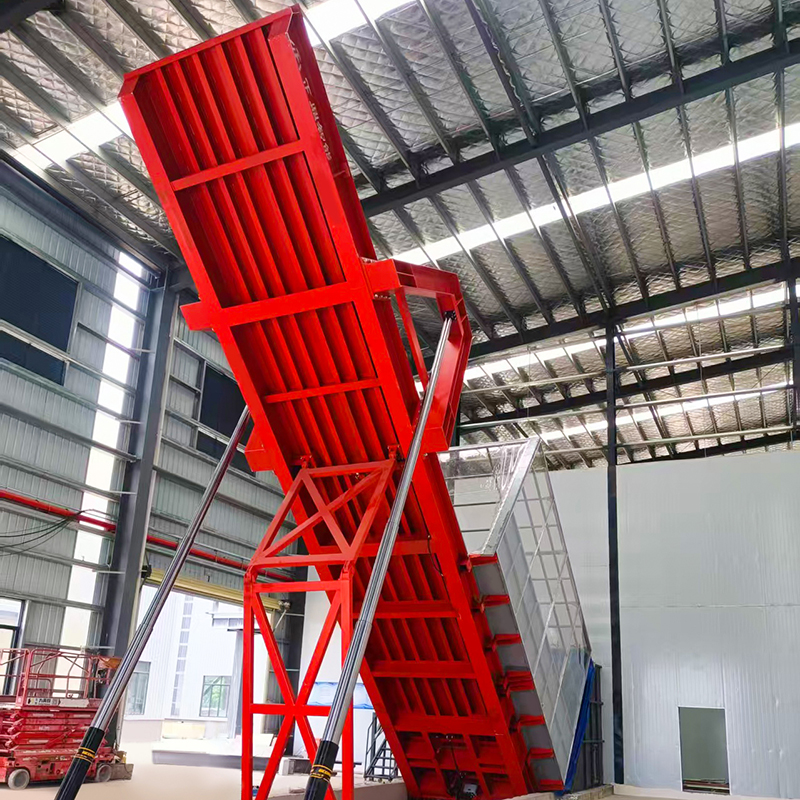 Enclosed Truck Dumper with Dust Control SystemA sealed enclosure is used to prevent dust overflow. The pit enclosure and the truck dumper platform enclosure achieve a combination of dynamic and static sealing, whi...View Product →
| Component | Check interval | What to inspect | Warning sign |
|---|---|---|---|
| Hydraulic cylinders and hoses | Weekly | Leaks, rod scratches, hose abrasion, pressure drop | Slow tilt, visible oil, unusual noise |
| Platform and pivot pins | Weekly | Cracks, wear, misalignment, bolt torque | Noise, raised gaps, vibration |
| Weighing system | Monthly | Calibration, junction boxes, cable condition | Off-weight readings, unstable zero |
| Dust collection | Daily to weekly | Filter pressure drop, duct leaks, fan buildup | Visible dust, high pressure differential |
| Safety interlocks | Daily | Vehicle restraint, hydraulic lock, warning devices | Movement with warning, platform drift |
Safety procedures should never become an afterthought. No personnel should be allowed to remain inside the truck cab or trailer while the platform is lifting. Wheel chocks and automatic restraints should be used on every load. Emergency stop buttons must be visible and tested regularly. Lockout and tagout procedures should cover hydraulic pressure, electrical power, and conveyor drive motors before any maintenance begins. Drivers and receiving crew need clear training on hand signals, radio communication, and the maximum vehicle weight and position allowed on the platform.
For dusty materials, an enclosed truck dumper with dust control is the best starting point because it contains the material path from the trailer gate to the hopper. The dust collector should have enough filter area for the actual air volume generated during discharge. A common mistake is to size the collector only for normal dust loading and ignore the surge when a full truck empties in eight seconds. Oversizing the dust collector is usually cheaper than retrofitting a larger fan and filter later.
Key takeaway: A maintenance plan for bulk material handling equipment should focus on hydraulics, scale accuracy, dust collection, and safety interlocks, because these four areas cause most of the downtime and incidents at a receiving station.
Frequently Asked Questions About Bulk Handling Material
What is bulk handling material?Bulk handling material is any loose product that is moved, stored, and processed in large volumes, such as cement, coal, grain, wood chips, plastic pellets, flour, sugar, and chemicals. Bulk handling refers to the system that receives, conveys, and loads these products without packaging them into individual units. |
How does a bulk material handling system work?It works as a continuous path from vehicle to storage or process. A truck dumper tilts the vehicle into a hopper, a conveyor carries material upward or horizontally, and a diverter sends it into the correct silo. The system may include weighing, dust collection, magnets, screens, and automation to protect both the product and the equipment. |
Which bulk material handling equipment is best for dusty products?An enclosed truck dumper with a dust control system is usually the right choice for cement, fly ash, lime, and fine chemical powders. It contains the discharge area and captures airborne dust before it reaches the operator and the environment. The receiving hopper, transfer point, and silo vent should also be connected to the same dust collection network. |
Can a truck dumper handle different bulk materials?Yes, but the changeover requires consideration of moisture, dust, and contamination. A dumper with smooth steel platform, sealed tailgate area, and easy washdown can handle grain, minerals, and industrial powders. The receiving hopper and conveyor should be cleaned between materials if cross-contamination is not acceptable. |
What is the difference between a pitless and a shallow foundation truck dumper?A pitless dumper sits mostly above grade and requires no deep excavation, but it often needs a ramp for the truck. A shallow foundation dumper has a reduced pit depth that still places the platform closer to grade. Both are useful for retrofit sites, but the shallow foundation model usually offers a more direct material flow and less ramp length. |
How do unattended truck dumpers improve accuracy?Unattended systems combine vehicle recognition, automatic positioning, integrated weighing, and PLC control. The scale records gross and tare weight without manual data entry, reducing transcription errors. The control system can also compare received tonnage against purchase orders and reject vehicles that are overweight or misaligned. |
Key takeaway: Bulk handling material questions usually come back to the same decisions: how much material needs to move, how dusty or abrasive it is, and how much automation is justified by labor and accuracy goals.
Related Resources and Next Steps
If you are planning a bulk handling material receiving station, start from the receiving point and work backwards. Define the worst day in terms of truck arrivals, the most difficult material by flow and dust behavior, and the space available for civil works. Then match those parameters to a truck dumper, a container flipper, and the necessary conveyor or dust control equipment. This approach reduces the risk of under-specified equipment, expensive site changes, and unsafe operating procedures.
- Read about our manufacturing approach for bulk material handling equipment
- See examples of truck dumpers used across industries
Wholesale buyers, engineering firms, and plant operators can also ask their selected manufacturer for reference lists, installation photos, and operating data from similar projects. A trustworthy equipment supplier should be able to discuss cycle times, foundation requirements, spare parts availability, and the maintenance training that comes with the system. The goal is to make the first day of operation as smooth as the thousandth truck cycle.
Key takeaway: Choosing the right bulk handling material system is a balance between throughput, material behavior, site conditions, and automation; get that balance right, and the receiving station becomes a reliable gate to the entire plant.


