

 English
 русский
 Español
 Français
 Português
 عربى




+86-13588556918
Content
- 1 What Is Material Handling Equipment?
- 2 Main Material Handling Equipment Categories
- 3 Truck Dumpers for Bulk Material Handling
- 4 Container Loading and Unloading Equipment
- 5 How to Select Material Handling Equipment
- 6 Maintenance and Safety Guidelines
- 7 Material Handling Equipment FAQ
- 7.1 What is material handling equipment used for?
- 7.2 What is the difference between a truck dumper and a side tippler?
- 7.3 How long does it take to install a truck dumper?
- 7.4 Can a truck dumper handle different types of trucks?
- 7.5 How do I choose a reliable material handling equipment manufacturer?
- 7.6 Do container flipping machines require special power and foundations?
- 8 Where to Start with a Material Handling Equipment Project
What Is Material Handling Equipment?
When a truck carrying 40 tons of grain arrives at the plant gate, the last thing the receiving team wants is a queue of vehicles waiting for one forklift and four workers with shovels. The material handling equipment placed between the truck and the storage silo decides how fast that load moves, how many people are needed, and whether anyone gets hurt.
Material handling equipment is the collective term for mechanical systems used to move, store, control, and protect materials throughout a production or logistics process. It includes conveyors, cranes, forklifts, truck dumpers, container loaders, palletizers, racking, and the control systems that connect them. In a bulk material plant, the most visible pieces are often the unloading machines at the receiving pit and the conveying lines that carry material into storage.
The conclusion is simple: the right material handling equipment reduces labor, improves throughput, and lowers safety risk, while the wrong choice creates long queues, material spillage, and costly maintenance. That is why procurement teams should spend more time on application data, material properties, and site constraints before comparing product prices.
For buyers searching for a material handling equipment manufacturer, the first distinction to understand is the difference between bulk handling equipment and unit handling equipment. Unit handling moves individual loads such as cartons, pallets, or parts; bulk handling moves loose materials such as grain, coal, cement, or fertilizer. A supplier with a complete product range can usually explain both categories, but the two require different engineering methods.
- Transport equipment moves material from one place to another, such as belt conveyors, screw conveyors, and bucket elevators.
- Positioning equipment changes the orientation or location of a load, such as a container tilter or a truck dumper platform.
- Unit load formation equipment groups smaller items into a single load, such as palletizers and stretch wrappers.
- Storage equipment holds materials between processes, such as silos, racks, and flow bins.
- Engineered systems combine machines, controls, and software to automate a complete flow.
- Identification and control equipment tracks material and equipment, such as weighing systems and sensors.
In the rest of this article, we will focus on the receiving and loading end of a bulk material site: truck dumpers, side tippers, and container loading and unloading equipment. These machines often set the speed for the entire plant.
Key conclusion: Material handling equipment is the backbone of free-flowing logistics, and the receiving station is usually the first place to improve.
Main Material Handling Equipment Categories
Material handling equipment is not a single machine. It is a family of systems designed for specific tasks in a logistics or production network. Understanding these categories helps a buyer identify where the real bottleneck is and which equipment deserves the first investment.
The conventional classification divides equipment into six groups: transport, positioning, unit load formation, storage, engineered systems, and identification and control. Each group has a distinct role, but in practice the groups work together.
| Category | Common Equipment | Typical Applications |
|---|---|---|
| Transport equipment | Belt conveyor, screw conveyor, bucket elevator, chain conveyor | Moving grain, coal, cement, minerals, and packaged products |
| Positioning equipment | Truck dumper, side tippler, container tilter, lift table | Emptying trucks, railcars, and containers safely |
| Unit load formation equipment | Palletizer, stretch wrapper, shrinking machine | Grouping bags and cartons for storage or shipment |
| Storage equipment | Silos, bins, racks, mezzanine floors | Holding raw material between delivery and production |
| Engineered systems | Automated storage and retrieval systems, sortation lines, integrated unloading lines | High-speed distribution or automated process feeding |
| Identification and control equipment | Weighing scales, barcode readers, sensors, control cabinets | Measuring material into production and tracking inventory |
In a complex plant, these groups work together. A truck dumper positions the truck, a hopper receives the material, a belt conveyor transports it, and a weighing system records the amount. For grain handling, the same combination appears in flour mills, feed plants, and oilseed processing. For coal and minerals, dust control and abrasion resistance may matter more than speed.
Engineered systems deserve special attention because they combine several types of equipment into one automated flow. A receiving station for bulk materials can include a truck scale, a truck dumper, a hopper, a belt conveyor, a bucket elevator, and a control room. If any part of that chain stops, the whole intake process slows down. That is why reliability and synchronization are more important than any single piece of machinery.
From a procurement standpoint, the category also determines whether the equipment is standard or custom. Conveyors and forklifts are often bought from catalogs. A truck dumper, by contrast, must be matched to the plant foundation, the trailer length, the height of the receiving hopper, and the material that will be dumped. This is where a direct manufacturer relationship makes a difference.
Key conclusion: Material handling equipment works as a system, and the selection process should start with the complete flow rather than a single machine.
Truck Dumpers for Bulk Material Handling
When a bulk truck arrives at a plant, the quickest way to empty it is to let gravity do the work. A truck dumper raises the vehicle or its container to a controlled angle, allowing grain, mineral, and other loose material to slide out into a receiving pit or conveyor. This simple principle has made truck dumpers one of the most valuable pieces of material handling equipment in industries such as steel, chemical, cement, coal, food, and agriculture.
The key structural elements are the platform, the hydraulic cylinders, the hinging system, and the supporting concrete work. The platform holds the truck while the cylinders lift one edge. Because the truck is heavy and the load shifts as it pours out, the hydraulic system must move both sides at the same speed. That is why a manufacturer with experience in mechanical cylinder synchronization matters in high-capacity models.
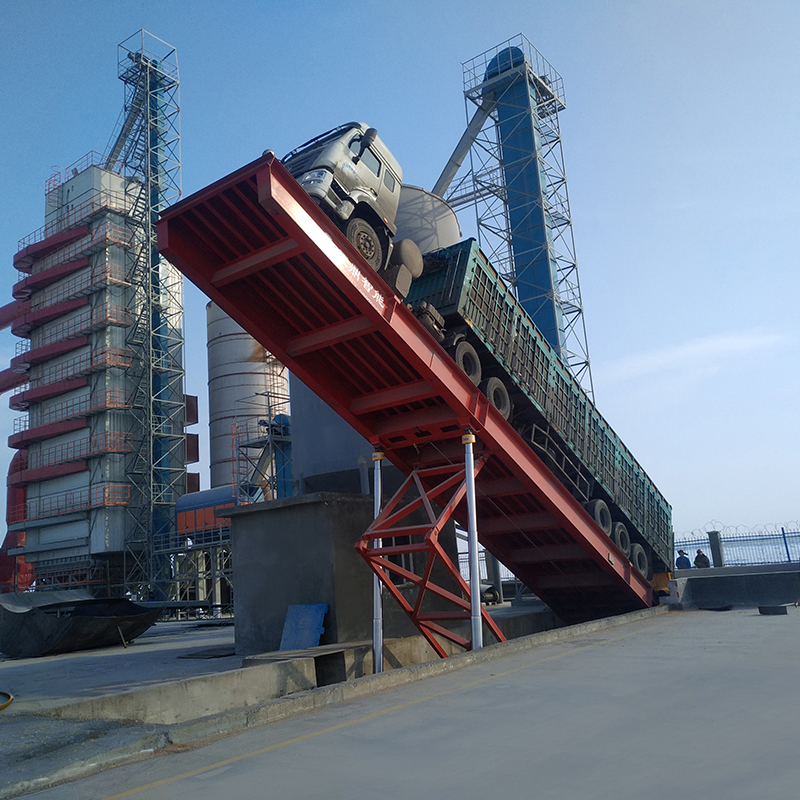 Mechanically Synchronized Truck Dumper for Heavy-Duty UseThis model uses a rigid mechanical synchronization system instead of flow control, improving reliability and safety under high-volume truck arrivals. Ideal for plants handling 80 trucks daily.View Product →
From a buyer's perspective, the choice is not only about price. It is about the foundation, the material being handled, the truck arrival frequency, and the safety requirements around the receiving pit. A plant expecting 80 trucks per day needs a different solution from a plant expecting 8 trucks per week.
Common Types of Truck Dumpers
Pit-Type Dumper
Fixed in a concrete pit.
Good for permanent receiving
stations with high daily volume.
Shallow Foundation
Reduced excavation depth
for sites with high groundwater,
rock, or existing utilities.
Pitless Dumper
No deep pit required.
Useful for existing plants,
temporary sites, or weak
soil conditions.
Mobile Dumper
Can be moved between
unloading points.
Fits operations with multiple
receiving locations.
Enclosed Dumper
Equipped with a dust control
system. Best for dusty materials,
chemicals, and food ingredients.
Unattended Dumper
Designed for automatic
operation. Often integrated
with a weighing system and
a plant control network.
Side-turn truck dumpers tilt the platform sideways instead of from the rear. This design is useful when the receiving hopper is located beside the truck lane or when a conventional rear discharge cannot reach the conveyor. Automatic side-turn models add controls that reduce operator input, which can make a significant difference in plants running continuous shifts.
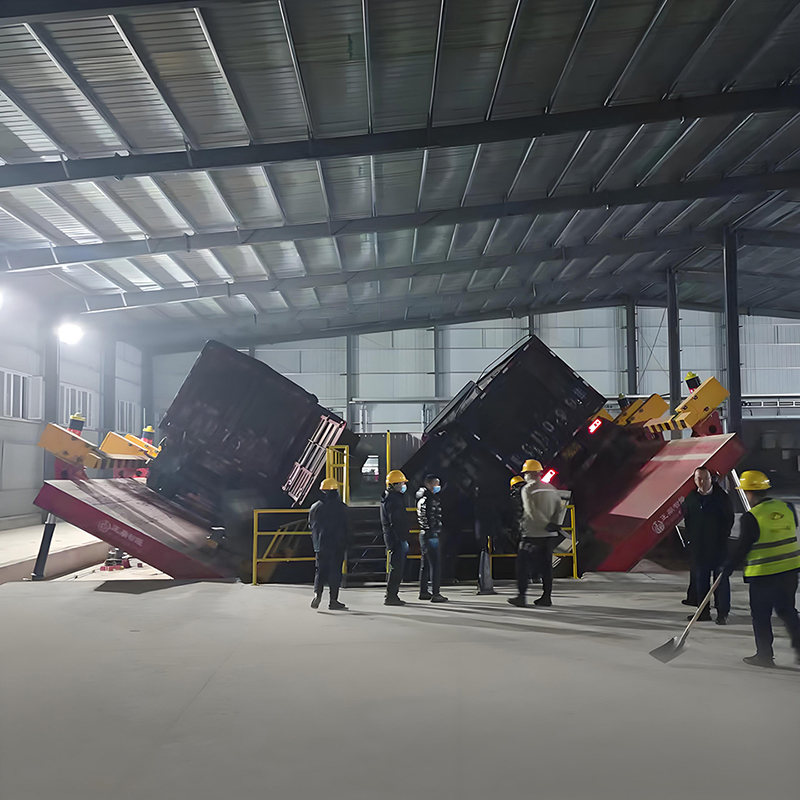 Automatic Side-Turn Truck Dumper with Remote ControlSide-tilt design allows unloading beside the lane while fully automatic controls reduce operator intervention. Suitable for continuous shifts in mining, metallurgy, and bulk material yards.View Product →
| Type | Best For | Main Limitation |
|---|---|---|
| Pit-type | High-volume fixed receiving | Deep excavation and more civil work |
| Shallow foundation | Sites with high groundwater or rock | May have slightly lower capacity or angle |
| Pitless | Existing plants with no pit | May need ramps and more ground space |
| Mobile | Multiple sites or temporary yards | Lower throughput and more setup time |
| Enclosed | Dust-sensitive materials | Higher cost for enclosure and air filtration |
| Unattended | Automated process lines | Higher investment in controls and sensors |
Truck dumpers are widely used across industries. In steel mills, raw materials such as iron ore, limestone, and coal arrive in large trucks. In cement and chemical plants, dust control and spillage prevention are critical. In food and feed plants, hygienic design, gentle discharge, and easy cleaning matter. In oilseed, brewery, and grain facilities, the receiving station is often the first quality control point, because the material must arrive in the right condition and flow without damaging the product.
One common application is unloading fruit or other fragile materials. In that case, the dumper platform can be equipped with a buffer hopper. When the platform reaches a high angle, the material enters the buffer hopper and then drops gently onto a conveyor, reducing impact damage. This shows that a truck dumper is not a one-size-fits-all machine. The design should respond to the actual material being handled.
Key conclusion: Truck dumpers improve bulk receiving speed more than almost any other single machine, but the foundation and material characteristics determine which configuration is practical.
Container Loading and Unloading Equipment
Not all material handling equipment is designed for trucks. Containerized shipments create a different challenge because the material is packed inside a steel box that must be lifted, tilted, loaded, or emptied through a narrow door. Container loading and unloading equipment solves this problem by replacing manual labor with mechanical movement.
A container flipping machine, for example, rotates a container to a vertical or near-vertical position. Bulk material inside then falls out into a receiving hopper. This method is especially effective in grain, food ingredient, and mineral processing plants where containers arrive full and need to be emptied quickly.
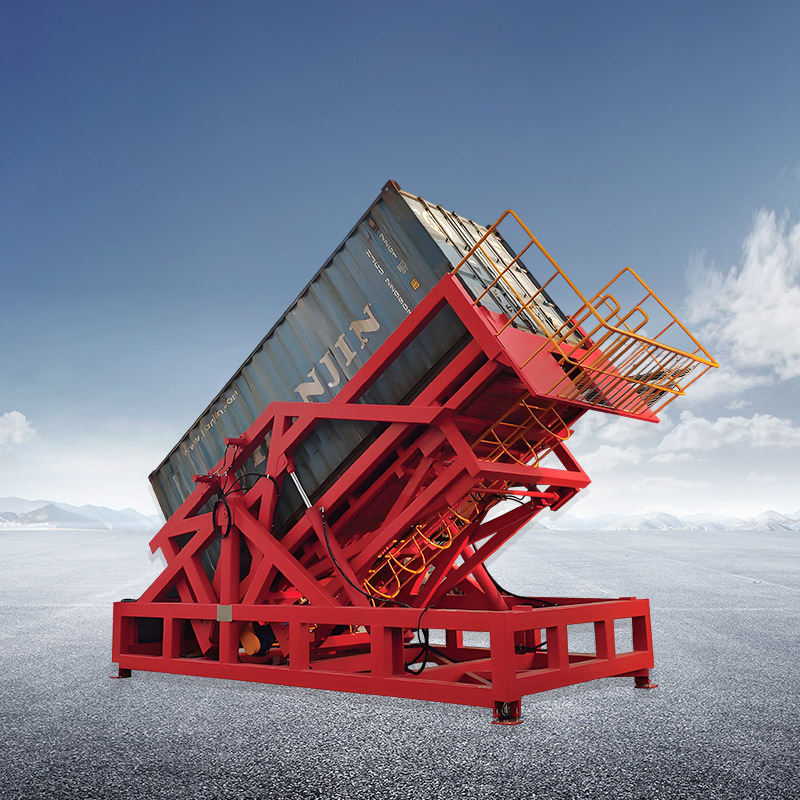 Container Flipping Machine for Bulk Material UnloadingRotates containers vertically for rapid gravity discharge. Hydraulic balancing and reinforced structure ensure stability. Useful in grain, mineral, and chemical processing plants.View Product →
For bagged products, a container loader is often the better choice. It consists of a belt that extends into the container and carries bags to the back. As the bags accumulate, the operator shortens the conveyor so that the load is built evenly from the far end to the door. This prevents bags from toppling over and reduces the physical strain on workers.
A continuous container handling system adds another level of efficiency. Instead of loading one container with a short conveyor, the system feeds material in a continuous flow while the container moves or the conveyor retracts. This is useful for high-volume operations handling rice, grains, pellets, or packaged products.
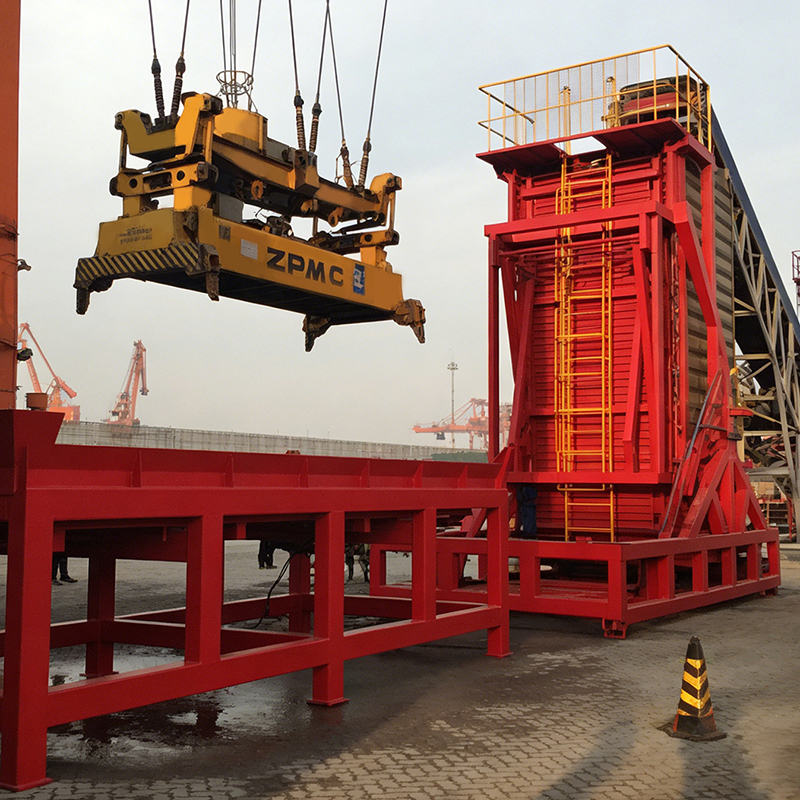
For applications that require a container to be lifted and tilted from above, a gantry container tilter provides more flexibility. It is often used when floor space below the container is limited, or when the material must be discharged from a specific side. This type of equipment can also be used for controlled emptying of smaller containers, bulk bags, or intermediate bins.
| Equipment | Core Function | Selection Note |
|---|---|---|
| Container flipping machine | Rotates a container to unload bulk materials | Good for grain, food ingredients, and minerals |
| Container loader | Extends a belt conveyor into a container | Best for bagged cargo or mixed shipments |
| Continuous container handling system | Feeds material into a container in a continuous flow | For high-volume operations with limited manual work |
| Gantry container tilter | Lifts and tilts a container from above | Useful when floor space below is limited |
When choosing container handling equipment, the first question is whether the material is bulk or bagged. Bulk material such as grains, oilseeds, and minerals can be discharged by flipping or tilting the container. Bagged material, on the other hand, needs a conveyor system that can reach deep into the container without damaging the packaging.
The second question is how the container arrives at the equipment. If containers are moved by forklift, the machine should include a guide system so the operator can position the container accurately. If the container is placed by a truck or crane, the machine must have enough clearance and a robust locking system.
The third question is dust and spillage. Unloading a container of dusty material requires a sealed receiving area and possibly a dust collector. Loading bagged material creates less dust but can still cause damage when bags slide or rub against the container floor. A good equipment layout should avoid sharp edges and pinch points.
Key conclusion: Container loading and unloading equipment should match the material form, the container handling method, and the required dust control level.
How to Select Material Handling Equipment
Selection is where many material handling projects succeed or fail. A machine that works well in one plant can become a constant problem in another because the material, truck, or site layout is different. The safest approach is to reduce the decision to a few controllable factors.
The first factor is material characteristics. Flowability, moisture content, particle size, abrasiveness, temperature, and dust level all influence the dumping angle and the receiving system. A fine, dusty powder needs sealed handling. A large, heavy rock needs a stronger platform and a slower tilt. Greasy seeds may flow easily, while sticky meal requires a higher angle or a vibrator.
The second factor is the truck fleet. The platform length and rated capacity must match the largest truck that will visit the plant. If the trailer is longer than the platform, the weight distribution changes during the lift. If the truck is heavier than the rated capacity, the dumper will bend or crack over time.
The third factor is site conditions. Deep pits require excavation, groundwater management, and concrete work. A shallow foundation design is better for sites with rock or existing pipes. A pitless dumper avoids excavation but needs more above-ground space. Mobile units offer flexibility but may not achieve the same throughput as a fixed unit.
Comparing the Level of Effort
Choosing among material handling equipment options goes beyond the purchase price. At the receiving point, the right unloading method changes labor demand, cycle time, and safety exposure. Many plant managers compare only the initial quotation and forget the costs of civil works, training, maintenance, and daily operation. A rough comparison of effort is useful when the plant handles bulk materials such as grain, fertilizer, or minerals. The chart below positions four common unloading approaches according to their relative operational complexity and manual involvement.
The chart uses a simple score from 0 to 100, where 100 means the highest labor demand and overall operating complexity. Manual unloading tops the list because it needs more people, more time, and more physical effort. A mobile truck dumper reduces some of that work, but the operator still has to move the unit into position and connect the power source. A pit truck dumper lowers daily effort because the dump angle and run-off are already built into the receiving area. An automated side truck dumper shows the lowest score because it is designed to operate with less manual involvement in repetitive unloading cycles. The difference between 35 and 20 may look small, but over hundreds of loads, that gap converts into meaningful labor savings. The graph does not mean that automation is always the best choice. If your trucks are old and have uneven frames, a simpler dumper may be easier to operate and maintain. If your site has a high forklift accident rate or a shortage of reliable workers, a more automated unit should have higher priority. The selected equipment must also match the material type and dust control requirements. In dusty applications, an enclosed dumper with a dust control system may deserve a separate score even if its foundation cost is higher. Use the graph as a starting point, not as the final engineering decision.
Selection Priorities and Common Mistakes
| Selection Priority | Common Mistake |
|---|---|
| Match capacity to the heaviest truck that will use the dumper. | Buying only for the average truck and stressing the machine when a heavier truck appears. |
| Confirm that the receiving pit and conveyor inlet fit under the raised platform. | Choosing a machine before checking the conveyor position. |
| Ask about dust control and material spillage. | Ignoring dust collection until the local environmental inspection fails. |
| Plan for future automation and weighing integration. | Thinking the control system can be added later without extra cost. |
| Review after-sales service and spare parts. | Assuming a cheaper machine has the same service support. |
| Compare total installed cost, including civil works. | Comparing only the equipment price and missing foundation costs. |
Another important factor is the supplier's experience. A manufacturer that designs shovels, side tippers, and container systems in the same facility can more easily adapt the design to a customer's process. International shipping experience also matters because the supplier must deliver machines to different ports, provide installation drawings, and support long-distance commissioning. Many companies source material handling equipment through a trader or wholesaler, but the manufacturer should still be the one answering technical questions.
Key conclusion: The best material handling equipment selection is based on material, truck, foundation, throughput, and total installed cost, not on the lowest quotation alone.
Maintenance and Safety Guidelines
A truck dumper or container handling machine is a heavy piece of material handling equipment. It can work for years if maintained well, or it can fail quickly if operators ignore warning signs. The maintenance plan should be written down, and every inspection should be recorded.
Hydraulics are the most common source of trouble. Low oil level, dirty filters, worn seals, and loose hoses reduce lifting speed and allow the platform to drift. The oil should be checked regularly, and the filter should be changed according to the manufacturer's schedule. Hydraulic leaks not only waste oil but also create slippery surfaces around the pit.
Structural inspection is equally important. Weld seams, hinge pins, platform stiffeners, and roller guides should be checked for visible cracks or deformation. The safety stops and limit switches prevent the platform from moving beyond its allowable range. If these switches are damaged or bypassed, the operator loses a critical safety defense.
| Interval | Checklist | Typical Action |
|---|---|---|
| Daily | Hydraulic leaks, warning lights, pit cleanliness, platform position | Clean, record, and report faults |
| Weekly | Hoses, fittings, limit switches, emergency stop | Tighten, adjust, and test |
| Monthly | Hydraulic oil level, filter indicator, pivot pins | Add oil or replace filter if needed |
| Quarterly | Cylinder synchronization, stops, welded seams | Run a no-load test and inspect for cracks |
| Annually | Structural inspection, hydraulic oil analysis, electrical inspection | Replace worn seals, oil, or sensors |
Container handling equipment has its own maintenance points. Belt-type loaders require regular checks of the belt surface, roller bearings, and drive motor. Container flipping machines depend on hydraulic power and locking pins. Gantry tilting equipment may use chains or wire ropes, which should be inspected for elongation, rust, and broken strands.
Safety should be considered before maintenance, not after an accident. Only authorized workers should operate the equipment. The area around the dumper should be kept clear during a lift. Drivers should not stay inside the truck while the platform is moving. Hydraulic pressure must be released before any hose repair. The emergency stop button should be visible and tested every week.
- Train every operator on the specific machine model, not only on general forklift or lifting equipment rules.
- Use a check sheet so operators do not skip important inspections.
- Keep a maintenance log with dates, findings, and replacement parts.
- Do not weld on hydraulic cylinders unless the manufacturer confirms that it is safe.
- Store spare parts such as seals, filters, hoses, and limit switches near the receiving station.
A well-maintained dumper is also more accurate. If the machine is equipped with an integrated weighing system, regular calibration is necessary. Dust accumulation on load cells can change the readings. Temperature changes can also affect hydraulic pressure and sensor output. A small investment in routine maintenance protects the accuracy of inventory control and prevents payment disputes with truck drivers.
Key conclusion: Maintenance is not an extra cost; it is the most direct way to protect uptime, safety, and weighing accuracy.
Material Handling Equipment FAQ
What is material handling equipment used for?Material handling equipment is used to move, store, control, and protect materials. It covers everything from a simple conveyor to an automated truck dumping system. In a manufacturing or logistics plant, the goal is to move the right amount of material to the right place at the right time, with minimal labor and maximum safety. |
What is the difference between a truck dumper and a side tippler?A truck dumper usually raises the rear of a truck so that material flows out through the back. A side tippler, also called a side-turn truck dumper, raises one side of the vehicle so that material discharges sideways. Side tipplers are useful when the receiving hopper is located beside the truck lane or when the layout does not allow a conventional rear dump pit. |
How long does it take to install a truck dumper?The installation time depends mainly on the civil work. A pit-type dumper requires excavation, concrete works, and curing time, so the project can last several weeks. A pitless dumper or mobile unit can be installed more quickly. Buyers should ask the supplier for a preliminary foundation drawing and installation plan before ordering. |
Can a truck dumper handle different types of trucks?Most truck dumpers can handle different vehicles as long as the platform length, width, and rated capacity match the vehicle size. The operator should position the truck according to the marked stop position. If the plant receives trucks with widely different axle lengths, the dumper may need a longer platform or multiple stop positions. |
How do I choose a reliable material handling equipment manufacturer?Look for a manufacturer with a complete product range, engineering capability, and export experience. Ask for references in your industry, request drawings, and visit the factory if possible. A reliable supplier will ask detailed questions about your material, trucks, and plant layout instead of giving a quotation after a short phone call. |
Do container flipping machines require special power and foundations?Container flipping machines usually use a hydraulic power unit, which can be electric or diesel depending on the model. The foundation must support the loaded container weight and the dynamic forces created during rotation. The supplier should provide a foundation drawing and clearly state the power requirements before installation. |
Key conclusion: A reliable equipment supplier should be judged by its engineering support, installation planning, and after-sales capability, not by price alone.
Where to Start with a Material Handling Equipment Project
If you are evaluating material handling equipment for a new plant or an existing bottleneck, write down the following details before contacting a manufacturer: material type, bulk density, moisture, truck capacity, truck height, hopper position, daily truck count, and available floor space. These numbers will determine whether a pit dumper, side tipple, or container flipping machine is the right first investment.
You do not need to become an equipment design expert. You do need a supplier who can show a complete product range, explain real installation constraints, and provide after-sales support. The better your site data, the more accurate the recommendation will be.
About the manufacturerRead about Jiangsu Zhengding Intelligent Equipment, a company that describes itself as a national high-tech enterprise specializing in intelligent logistics equipment. |
Contact the supplierSend your unloading requirements to the factory and ask for a recommended layout, preliminary drawings, and a quote. |
Key conclusion: The fastest way to improve a bulk material receiving process is to combine accurate site data with a manufacturer that can design the entire unloading system.


