

 English
 русский
 Español
 Français
 Português
 عربى
عربى



+86-13588556918
Content
- 1 What Container Loading and Unloading Equipment Does
- 2 How Container Loading and Unloading Equipment Works
- 3 Manual vs Automated Container Loading Equipment: A Practical Comparison
- 4 Container Loading Equipment Market Trends and Growth
- 5 Automation Adoption in Container Terminals
- 6 Choosing the Right Container Loading and Unloading System
- 7 Container Loading Safety Best Practices
- 8 Container Turning Machine: Structural Overview
- 9 About Jiangsu Zhengding Intelligent Equipment
- 10 Frequently Asked Questions
- 10.1 Q1: What container sizes can container loading and unloading equipment handle?
- 10.2 Q2: How much can automated container loading equipment reduce loading time?
- 10.3 Q3: Is manual container unloading still common in the industry?
- 10.4 Q4: What factors matter most when choosing container loading and unloading equipment?
What Container Loading and Unloading Equipment Does
Container loading and unloading equipment is the machinery used to move goods into and out of 20-foot and 40-foot shipping containers at ports, warehouses, and distribution centers. The main categories include telescopic conveyors, container turning (flipper) machines, rear and side tipping equipment, and forklifts, each suited to a different combination of cargo type and site layout. According to Grand View Research, the global container handling equipment market was valued at approximately USD 8.03 billion in 2024 and is projected to reach USD 10.31 billion by 2030, growing at a compound annual rate of roughly 4.4 percent, a trend driven largely by port modernization and a broader shift toward automated cargo handling equipment.
For warehouse and terminal operators, the choice between manual labor, semi-automated conveyor systems, and fully automated turning equipment directly affects dock time, labor requirements, and worker safety. This guide explains how container loading equipment works, compares manual and automated container loading equipment, and outlines the factors that matter most when selecting a system for a specific operation.
How Container Loading and Unloading Equipment Works
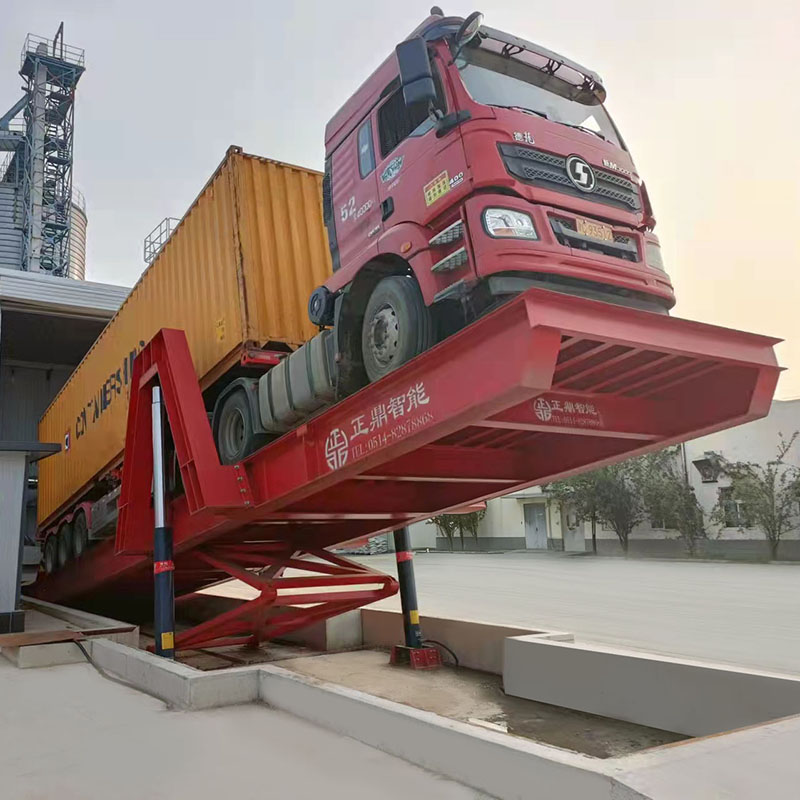
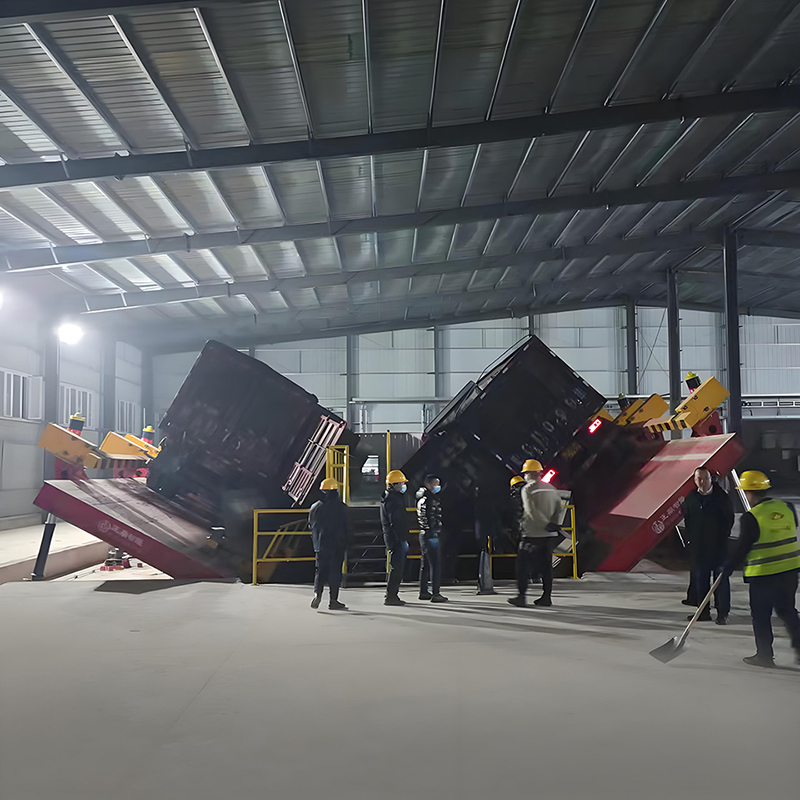
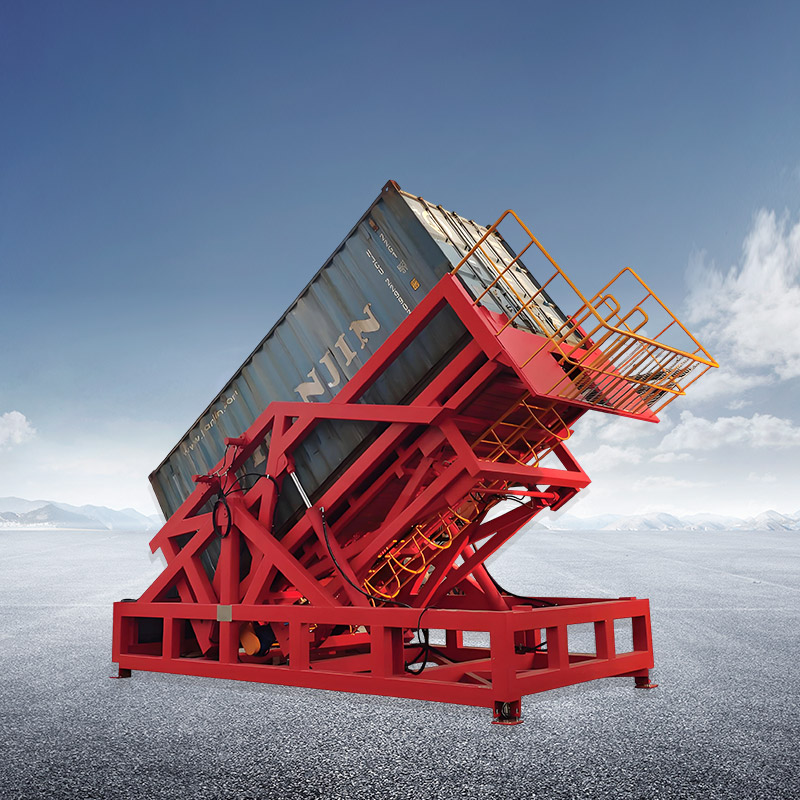
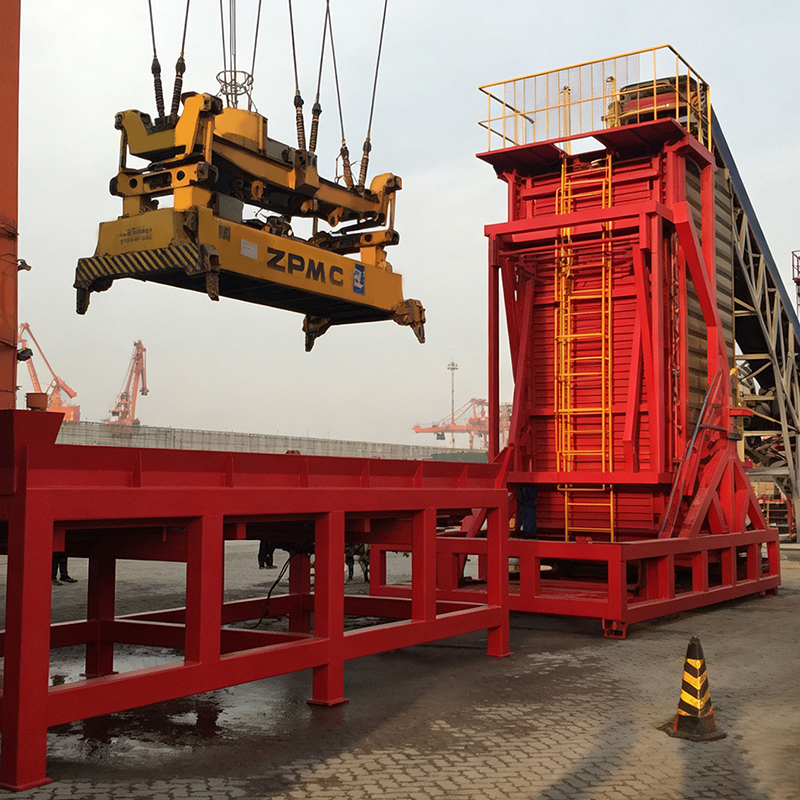
Different equipment types handle different cargo, but the underlying goal is the same: move material into or out of a container while limiting manual carrying distance and repetitive lifting. A telescopic conveyor extends a belt or roller section directly into the container so that boxed, bagged, or palletized goods can be placed onto a moving surface rather than carried by hand. A container turning or flipper machine clamps the entire container and rotates it so that bulk material such as grain, ore, or aggregate discharges through the open end by gravity, without workers entering the container. Rear and side dumping equipment lifts and tilts a container or vehicle to empty bulk cargo in a similar way, with the tilt direction chosen based on dock layout. Forklifts and reach stackers remain common for palletized loads but require workers to reach deep into the container, which limits their efficiency for long hauls.
A typical automated unloading sequence follows a consistent pattern regardless of the specific machine involved:
- Positioning and aligning the container with the loading dock or turning frame
- Securing or locking the container in place before any tilting or rotation begins
- Extending, tilting, or rotating the container to expose the cargo for discharge or access
- Transferring material continuously through a conveyor, chute, or gravity discharge path
- Retracting the equipment and releasing the container once the cycle is complete
Understanding how container loading equipment works in this sequence makes it easier to compare systems later in this guide, since each stage represents a point where automation can either save time or introduce a new safety consideration.
Manual vs Automated Container Loading Equipment: A Practical Comparison
Manual container unloading typically involves workers entering the container, carrying goods to the door or dock side, and handing them off for stacking or palletizing. Industry sources commonly report that unloading a standard 40-foot container by hand takes roughly two to three hours and requires four to five workers working continuously, since the carrying distance and repeated lifting become the main bottleneck as the container empties. Improving this bottleneck is one of the more direct ways operators look to improve logistics loading efficiency without redesigning an entire dock.
The chart above summarizes typical reductions in dock time reported by conveyor equipment suppliers when moving from fully manual unloading to telescopic conveyor-assisted unloading. Basic telescopic dock loaders are commonly reported to cut unloading time by around 30 percent, mainly by removing the need to carry goods by hand across the length of the container. Standard telescopic conveyor systems, which extend further and run continuously, are reported to reduce time by closer to 40 percent in typical warehouse settings. High-capacity conveyor lines, often paired with powered rollers and adjustable height controls, are associated with reductions of up to 50 percent in supplier-reported figures.
| Method | Typical Crew Size | Ergonomic Risk | Best Suited For |
|---|---|---|---|
| Manual unloading | 4-5 workers | High - repetitive lifting, confined space | Low volumes, mixed or irregular cargo |
| Telescopic conveyor-assisted | 1-2 workers | Reduced - shorter carrying distance | Palletized or boxed goods, high-frequency docks |
| Automated turning or tipping equipment | 1 operator, supervisory | Low - no manual container entry | Bulk material such as grain, ore, or aggregate |
General comparison of common container unloading methods; figures reflect typical ranges reported across industry sources.
Container Loading Equipment Market Trends and Growth
Demand for container loading and unloading equipment is closely tied to global trade volumes and the pace of port and warehouse modernization. Grand View Research reports that forklift trucks accounted for the largest equipment-type share, at 32.8 percent, in 2024, reflecting how widely this equipment class is deployed across warehouses, terminals, and manufacturing sites, even as more specialized automated systems gain ground in higher-volume operations.
This area chart plots the global container handling equipment market from an estimated USD 8.03 billion in 2024 to a projected USD 10.31 billion in 2030, with the years in between interpolated at the reported compound annual growth rate of 4.4 percent for illustration. The curve is gradual rather than sharp, which is consistent with a mature equipment category where growth comes from steady port expansion and fleet replacement rather than a single disruptive shift. Growth is fastest in regions investing heavily in new port infrastructure, with Asia-Pacific cited as the largest and fastest-growing regional market. The steady upward slope also reflects continued containerization of global freight, since more containerized cargo generally translates into more demand for handling equipment at each stage of the supply chain. For operators evaluating new equipment purchases, this trend line suggests a market that is expanding but not overheating, which supports a measured approach to upgrading from manual to automated systems rather than a rushed one.
The gauge above reflects Grand View Research's finding that the Asia-Pacific region held a 35.7 percent share of the global container handling equipment market in 2024, the largest of any region tracked in the report. This concentration lines up with the region's role as the center of global container manufacturing, port throughput, and export-driven manufacturing. It also means that warehouse container handling automation trends in Asia-Pacific often set the pace for equipment design elsewhere, since suppliers frequently develop new configurations for high-volume regional ports before adapting them for other markets. For buyers outside the region, this can translate into more mature, field-tested equipment options as designs move from high-throughput deployments into general availability. The needle position on the gauge, sitting just past the one-third mark, illustrates that while Asia-Pacific leads, more than sixty percent of global demand still comes from other regions, which keeps the market meaningfully diversified.
Automation Adoption in Container Terminals
Despite steady market growth, the shift from manual to automated container handling is still at an early stage globally. Grand View Research, citing research published through PubMed Central, notes that only about 3 percent of the world's container terminals were found to be fully or semi-automated. This low figure reflects the high upfront investment automation requires, along with the practical challenge of retrofitting older terminals and warehouses that were not originally designed around automated equipment.
This donut chart shows the split between terminals that operate with full or partial automation and the much larger group that still relies mainly on conventional, labor-intensive methods. The narrow red sliver at the top represents the roughly 3 percent of terminals classified as automated or semi-automated, while the surrounding ring represents the 97 percent that have not yet made that transition. This gap is one reason automated container loading system benefits, such as reduced dock time and lower manual handling risk, are drawing increasing attention from operators looking to modernize incrementally rather than all at once. It also suggests significant remaining headroom for equipment suppliers, since even modest increases in automation adoption represent a large absolute number of terminals and warehouses. For most operators, the practical path forward is not a single large automation project but a series of targeted upgrades, such as introducing a telescopic conveyor at the busiest dock door or a container turning machine for the highest-volume bulk cargo line. Read alongside the market growth chart above, this chart suggests that revenue growth in the sector is currently driven more by fleet renewal and moderate automation upgrades than by wholesale replacement of manual processes.
Choosing the Right Container Loading and Unloading System
There is no single best container loading solution for every warehouse; the right choice depends on cargo type, throughput, and site layout. Bulk material such as grain, coal, or minerals is generally best handled by turning, tipping, or dumping equipment, since these systems avoid the need for workers to enter the container. Palletized, boxed, or bagged goods are usually better suited to telescopic conveyors or forklifts, since these loads need to remain intact and organized during transfer. Throughput volume matters as well: a dock handling a handful of containers per day may not justify the investment in fully automated equipment, while a high-frequency distribution center often recovers that investment quickly through reduced dock time and labor requirements.
| Equipment Type | Typical Cargo | Container Size | Automation Level |
|---|---|---|---|
| Rear dumper | Bulk material - grain, ore, aggregates | 20ft / 40ft | Semi-automated, operator-controlled |
| Side dumper | Bulk material, lateral-discharge layouts | 20ft / 40ft | Semi-automated, operator-controlled |
| Container turning / flipper machine | Bulk material needing full rotation for discharge | 20ft / 40ft | Semi- to fully automated |
| Telescopic conveyor | Palletized, boxed, or bagged goods | 20ft / 40ft | Manual loading onto an automated belt |
Comparison of common container loading and unloading equipment types by cargo suitability and automation level.
Good industrial container loading system design also accounts for site constraints such as dock height, available floor space for a turning frame, and whether the equipment needs to be fixed in place or mobile between multiple dock doors. Before selecting equipment, it helps to walk through a short list of practical questions:
- What proportion of shipments are bulk material versus palletized or boxed goods
- How many containers move through the site on a typical day or shift
- Whether existing dock doors and floor space can accommodate a fixed turning frame or conveyor
- What level of operator training and maintenance support is realistically available on site
- Whether manual entry into containers is currently a recurring safety concern that automation could reduce
Container Loading Safety Best Practices
Container loading safety best practices matter regardless of whether a site uses manual labor or automated equipment, since tilting, rotating, and conveying operations all introduce their own hazards if not managed carefully. The following practices are widely recommended across the industry for container loading and unloading operations:
- Inspect containers for structural damage, corrosion, or unstable cargo before beginning any tilting or turning operation
- Secure or lock the container to the turning frame or dumping cradle before any movement begins
- Keep personnel clear of the container during tilting, rotation, or conveyor extension cycles
- Use appropriate personal protective equipment, including footwear and eye protection, for any manual handling that remains part of the process
- Follow manufacturer-specified load limits for conveyors, cradles, and tipping frames rather than estimating capacity on site
- Schedule regular maintenance checks on hydraulic cylinders, drive motors, and locking mechanisms
- Train operators specifically on emergency stop procedures before allowing independent operation of turning or tipping equipment
Container Turning Machine: Structural Overview
The diagram below is a simplified isometric illustration of a container turning machine, one of the more common pieces of automated container loading system equipment used for bulk material discharge. It shows how the container sits within a rotating cradle mounted on a base frame, with a hydraulic cylinder providing the tilting or turning force.
The container cradle at the top holds the container in place during rotation and is sized to accommodate standard 20-foot and 40-foot units. The hydraulic tilting cylinder, shown as the diagonal gray member, provides the controlled force needed to rotate the cradle around the pivot hinge at its base, allowing the operator to set the tilt angle needed for complete bulk discharge. The base turning frame anchors the entire assembly to the ground and carries the combined weight of the container, cargo, and cradle throughout the rotation cycle. The control cabinet, positioned to the side for operator access, houses the switches and interlocks that govern the tilting sequence and the emergency stop function referenced in the safety practices above. Together these components illustrate why container turning equipment is generally classified as semi- to fully automated: once a container is secured, a single operator can complete a discharge cycle without physically entering the container.
About Jiangsu Zhengding Intelligent Equipment
Jiangsu Zhengding Intelligent Equipment Co., Ltd. is a national high-tech enterprise focused on the research, development, and manufacturing of intelligent logistics equipment. The company provides systematic solutions for the automatic loading and unloading of vehicles and containers across a range of industries, with a product line that includes rear dumpers, side dumpers, car loading equipment, and container flippers. This places it among the companies in China with a relatively complete range of automatic loading and unloading equipment for both vehicles and containers.
These products are used across the steel, chemical, cement, coal, grain, oil, and food industries, and are exported to countries including Japan, Brazil, Egypt, Pakistan, India, and markets across the Middle East and Southeast Asia. The company's automatic vehicle loading and unloading equipment holds a leading position in China by annual sales volume and technical performance, with international customers that include Budweiser, Heineken, Buhler Group, Wilmar International, Cargill, DuPont, Louis Dreyfus, Charoen Pokphand Group, and Saint-Gobain Group. Container loading and unloading equipment from Jiangsu Zhengding is designed for 20-foot and 40-foot containers, with various types of container turning machines configured to match specific process requirements and site conditions, supporting container loading and unloading across a range of specialized applications.
Frequently Asked Questions
Q1: What container sizes can container loading and unloading equipment handle?
Most container loading and unloading equipment, including turning machines, dumpers, and telescopic conveyors, is designed for the standard 20-foot and 40-foot containers used in international shipping, with configurations adjusted to match specific process requirements and dock layouts.
Q2: How much can automated container loading equipment reduce loading time?
Industry-reported figures from telescopic conveyor suppliers suggest reductions of roughly 30 to 50 percent compared with manual unloading, depending on equipment tier and cargo type, though actual results vary by site and are best treated as a general range rather than a fixed outcome.
Q3: Is manual container unloading still common in the industry?
Yes. Research cited by Grand View Research indicates that only about 3 percent of the world's container terminals are fully or semi-automated, meaning manual and semi-manual methods still account for the large majority of container handling worldwide.
Q4: What factors matter most when choosing container loading and unloading equipment?
The main factors are cargo type (bulk material versus palletized or boxed goods), daily container throughput, available dock space for fixed equipment, and the level of worker safety improvement the operation needs, such as reducing or eliminating manual entry into containers.


