

 English
 русский
 Español
 Français
 Português
 عربى




+86-13588556918
Content
- 1 What Is a Side Loader? Three Machine Families Behind One Name
- 2 How a Side Loader Works: Structure and Working Principle
- 3 Where Side Loaders Earn Their Keep: Applications and Materials
- 4 Cycle Time and Labour: What the Numbers Actually Look Like
- 5 Selection Criteria: Matching a Side Loader to Your Site
- 6 Automation, Weighing and Unattended Operation
- 7 Maintenance and Reliability: Keeping a Side Loader Working
- 8 Buying Checklist: What to Put in the Enquiry
- 9 Frequently Asked Questions About Side Loaders
- 9.1 What is the difference between a side loader and a forklift?
- 9.2 Can a side loader unload a sealed container without opening it?
- 9.3 How long does a side-turn truck dumper take per vehicle?
- 9.4 Do I need a pit, or can the equipment be installed at grade?
- 9.5 What capacity range is available?
- 9.6 How important is dust control?
- 9.7 Can unloading and weighing be combined?
- 9.8 How do I choose between several suppliers?
- 10 Working With a Side Loader Manufacturer
A 40-foot container of bagged resin arrives at 7:40 in the morning and the yard clock starts running. If two forklift operators need an hour and a half to strip that box by hand, one late arrival can push your inbound schedule into the night shift, and the demurrage bill follows a week later. A side loader is the category of equipment that removes that bottleneck, but the name covers three quite different machines, and buying the wrong one is an expensive way to learn the difference.
Here is the short answer before the detail: a side loader handles material or a whole vehicle from the side rather than from the end. In practice that means a side-loading forklift that carries long profiles through a 2.5 m aisle, a container side lifter that picks a box off a trailer and sets it on the ground, or a side-turn truck dumper that tilts an entire truck sideways and empties bulk cargo in two to three minutes. Which one you need is decided by the material, the load carrier, the site layout and the throughput you must hit at peak, not by the brochure photo.
If you are a plant engineer, a logistics manager or a procurement officer sourcing this equipment from a manufacturer, supplier or wholesaler, the useful questions are not "which brand" but "which family, which capacity, which foundation and which level of automation". This guide walks through the types, the working principle, realistic cycle times, selection criteria, maintenance practice and the risks that only appear after commissioning.
A side loader is not one machine: match the family, side-loading forklift, container side lifter or side-turn truck dumper, to the material before you compare prices.
What Is a Side Loader? Three Machine Families Behind One Name
Search results for the term side loader mix three product categories that share a principle but almost nothing else. They all approach the load from the side instead of the end, which is what makes them useful in tight yards, narrow aisles and congested docks. Beyond that, their capacity, footprint, cycle time and site requirements differ by an order of magnitude, so the first job is to work out which family your project actually belongs to.
1. Side-loading forklifts and multi-directional sideloaders
A side-loading forklift carries its load on a platform beside the driver rather than in front of the mast, so a 12 m steel profile or a bundle of timber turns inside an aisle that a conventional counterbalance truck cannot enter. Capacities typically run from 1 t to 8 t, and the fork carriage or platform sits at deck height, which shortens the lift cycle when the load only needs to travel a few hundred metres. The trade-off is ground condition: these machines want a flat, well-compacted concrete floor, and they are not designed for bulk material at all.
2. Container side lifters and side loader trucks
A container side lifter is a road-going vehicle with hydraulic lifting frames on both sides. The driver straddles the container, the frames drop, lock onto the corner castings, lift the box off the trailer, and set it directly on the ground or on a second chassis. No crane, no reach stacker and no dedicated terminal are required, which is why these units are common at rail sidings, inland depots and factories that receive one or two containers a day. The critical specification is the lifting capacity at the maximum outreach, not the headline number in the sales brochure, because capacity falls sharply as the frames extend.
3. Side-turn truck dumpers and side-tilt platforms
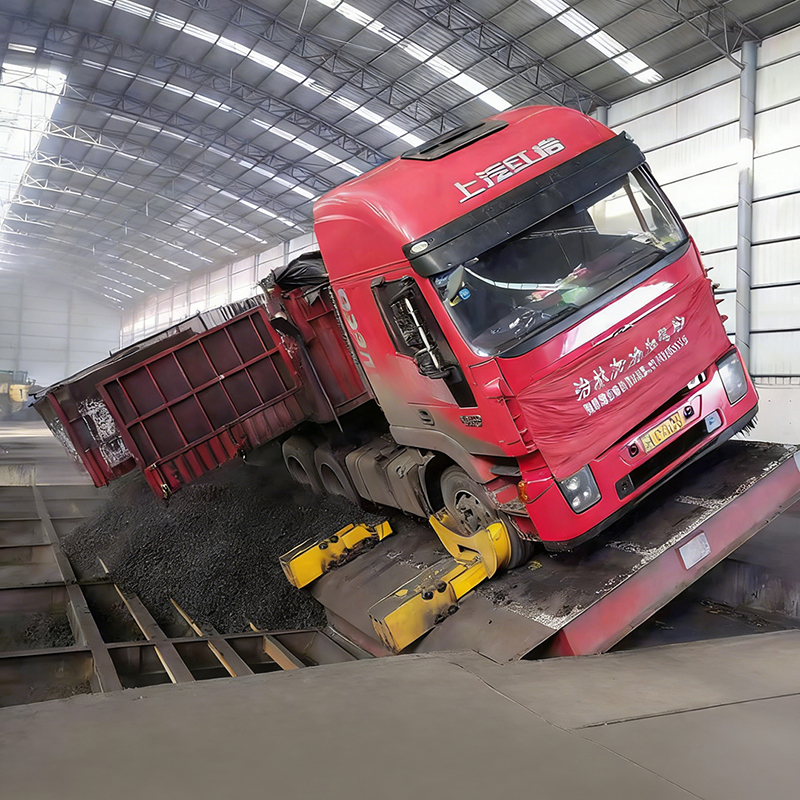
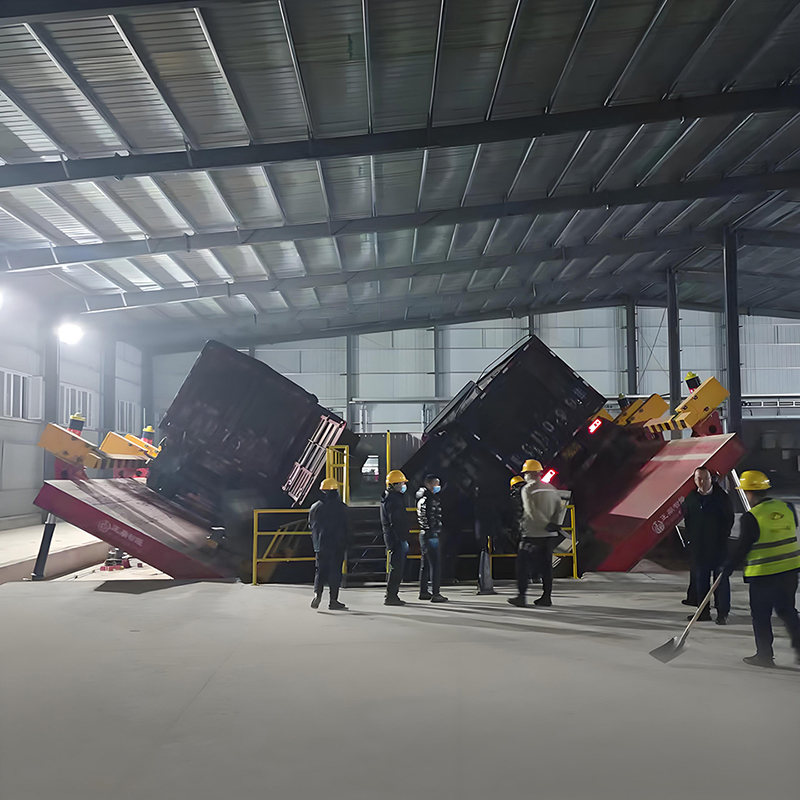
A side-turn truck dumper, also called a side tipper or side-discharge unloader, tilts the entire truck or trailer sideways instead of raising it at the rear. The platform lifts at an angle of roughly 60 to 75 degrees, the tailgate or side gate opens, and the bulk cargo slides out into a receiving hopper or pit. Cycle times of two to four minutes per truck are normal for free-flowing materials, and the sideways motion keeps the discharge height low, which reduces dust and mechanical stress on the vehicle's own tipping gear. This is the family that most industrial plants mean when they talk about unloading bulk raw material at high throughput.
| Family | What it moves | Typical cycle | Best fit | Main limits |
|---|---|---|---|---|
| Side-loading forklift | Long profiles, timber, pipes, palletised goods, 1 to 8 t | 2 to 6 minutes per load | Steel service centres, narrow-aisle warehouses, fabrication shops | Flat concrete required; no bulk material capability |
| Container side lifter | 20 ft and 40 ft containers, 20 to 40 t | 5 to 10 minutes per box | Depots, rail sidings, factories receiving containers in small batches | High capital cost, trained operator, road transport regulations |
| Side-turn truck dumper | Bulk material in tipper trucks, up to 60 t per vehicle | 2 to 4 minutes per truck | Cement, coal, grain, ores, biomass, chemical raw material | Fixed installation, foundation or platform, dust control needed |
Notice how the decision narrows itself once the material is defined. If the load arrives palletised or as long sections, you are buying handling equipment; if it arrives sealed in a container, you are buying lifting capacity and outreach; if it arrives loose in a tipper body, you are buying a fixed unloading station and the civil works that come with it.
Decide the family first: palletised and long loads point to handling equipment, sealed boxes to container lifting, and loose bulk to a fixed side-turn unloading station.
How a Side Loader Works: Structure and Working Principle
Whether the machine carries a container or tips a truck, the core is the same: a rigid frame, one or more hydraulic cylinders, a synchronization method that keeps the two sides moving together, and a set of interlocks that prevent the sequence from starting until the vehicle is positioned and the safety conditions are met.
Frame and lifting geometry
On a container side lifter, the frame is a pair of vertical columns mounted on the chassis, each carrying a sliding lifting arm that engages the corner castings. On a side-turn truck dumper, the frame is a steel platform with a side hinge, driven by two or four cylinders mounted underneath. The hinge position determines the discharge trajectory and therefore the size and position of the receiving pit or hopper. Getting the hinge geometry wrong is one of the most common design mistakes, because it is discovered only when the first sticky material refuses to slide.
Cylinder synchronization and safety
If the two sides of a tilting platform move at different speeds, the chassis twists and the frame takes a load it was never designed for. Manufacturers address this either electronically, with displacement sensors and proportional valves, or mechanically, with a rigid linkage that forces both cylinders to travel together. A mechanical cylinder synchronization system is attractive in dusty plants because there are no sensors to drift or foul, and the synchronization accuracy stays consistent over the life of the linkage. Regardless of the method, look for interlocks on wheel position, side-gate status, platform angle and hydraulic pressure, because these are what turn a powerful machine into a safe one.
Discharge, dust and metering
Once the platform passes roughly 45 degrees, the material begins to flow. Free-flowing aggregates and grain slide cleanly; damp clay, filter cake and some food products need a steeper angle, a vibrated platform surface or a lined hopper to prevent build-up. Where dust is a problem, an enclosed unloading station with extraction ducting keeps the operation inside a controlled volume instead of releasing a plume over the yard. Where the material is also being bought and sold, an integrated weighing system removes a separate weighing step and gives you the net weight of every load in the same transaction as the discharge.
Frame geometry and cylinder synchronization decide whether a side loader runs for fifteen years or becomes a maintenance case study within eighteen months.
Where Side Loaders Earn Their Keep: Applications and Materials
Side unloading equipment is deployed wherever bulk raw material or long goods arrive faster than the receiving area can absorb them. The industries that dominate the installed base are steel, chemicals, cement, coal, grain, oils and food processing, followed by biomass power, fertiliser blending and port or rail transfer operations.
Bulk raw material in tippers
Cement plants, coal yards and chemical works receive material in tipper trucks and trailers that would otherwise need a rear tipper pit and a long reversing manoeuvre. A side-turn platform allows the truck to drive on in a straight line, which is safer and faster in a congested yard. Grain and oilseed processors value the same machines for a different reason: the low discharge height protects the product from impact damage and reduces the amount of dust released at the receiving hopper.
Long goods and narrow aisles
Fabricators and steel distributors use side-loading forklifts because the load simply does not fit through the door on a conventional truck. A 12 m beam carried at the side can be steered through a 3 m aisle, which often means a rented building can be used as it stands rather than rebuilt around the handling method.
Containers and mixed cargo
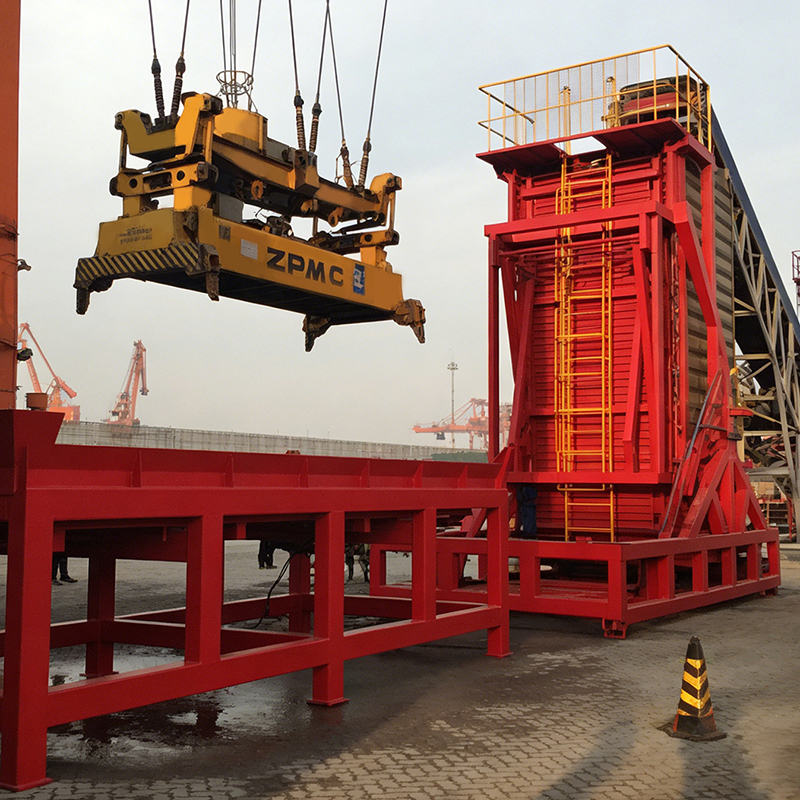
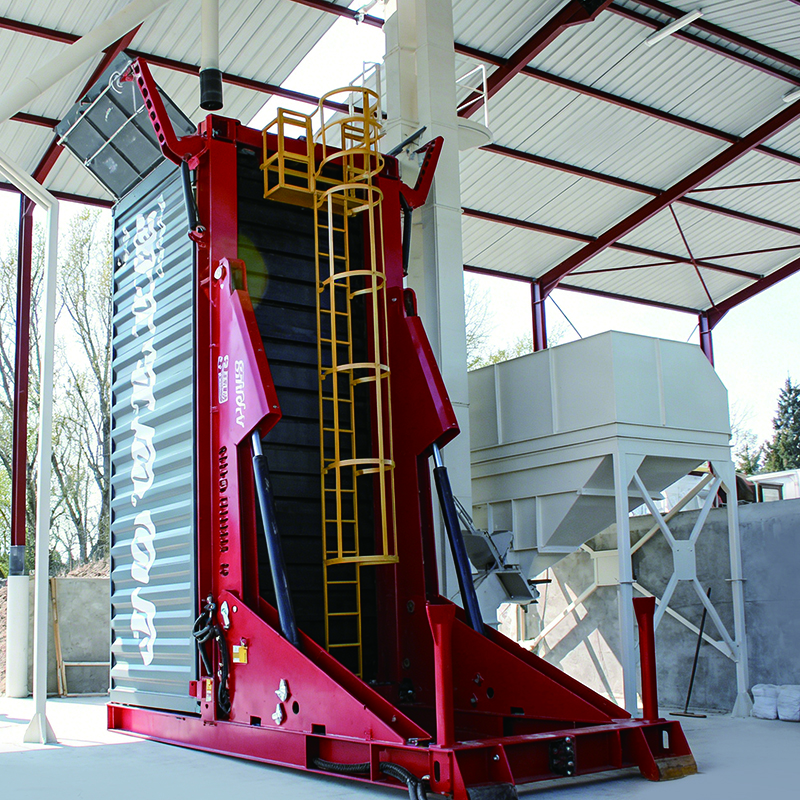
Factories that receive raw material, packaging and spare parts in the same week usually need both container handling and bulk unloading. Container tilting machines let a sealed box be opened, tilted and emptied into a hopper in a controlled way, while container loaders and continuous container handling systems support the outbound side of the same building.
Product-sensitive cargo
Not every material tolerates a rapid tip. One documented example from the equipment maker Jiangsu Zhengding Intelligent Equipment is a food application in which a truck unloader empties oranges. A buffer hopper sits inside the discharge path so that, as the tipping angle increases, the fruit enters the hopper first and then falls a short, controlled distance onto the conveyor instead of dropping the full height of the platform. That kind of adaptation, engineered around damage thresholds rather than around tonnage, is what separates a supplier of systems from a supplier of steel.
The receiving end matters as much as the unloading end. A machine that empties a 60 t trailer in three minutes creates a 20 t per minute surge at the hopper, and the conveyor, screener and silo downstream must be sized for that surge rather than for the daily average. Throughput calculations based on average tonnage consistently under-size the receiving system, and the resulting bottlenecks are often blamed on the unloader.
Size the receiving conveyor and hopper for the peak discharge rate, not the daily average, or the side loader will be blamed for a bottleneck it did not create.
Cycle Time and Labour: What the Numbers Actually Look Like
Before comparing quotations, it helps to compare unloading methods on a single scale. Vendors describe their machines in tons per hour, which is hard to hold in your head when the inbound plan is written in trucks per shift. The chart below converts four common methods onto one index, using manual forklift destuffing of a 40-foot load as the 100 baseline, so you can see the relative size of the gap rather than a single vendor's claim.
The index is built from the time needed to get the material out of the carrier and into a workable state, including positioning, the unloading motion itself and the vehicle leaving the bay. It excludes customs, sampling and quality inspection, because those steps consume the same hours whichever machine you buy. It also assumes a competent operator, since a poorly trained operator can double the cycle of any method listed. The figures are typical rather than guaranteed, and sticky or frozen material will move every bar to the right. Use it as a screening tool to decide which family deserves a site visit, then ask each supplier to quote against your own material data.
Relative unloading time per 40 ft load (manual forklift destuffing = 100)
Manual forklift destuffing, two operators
Side-loading forklift, one operator
Rear tipper truck dumper
Side-turn truck dumper
Index based on typical positioning, unloading and vehicle departure times; material-specific results vary.
The first point the chart makes is that the gap between manual destuffing and powered unloading is not incremental, it is structural. When a side-turn truck dumper sits at 12 on the index, the unloading step has effectively stopped being the constraint in the inbound process, and the limiting factor moves to weighbridge capacity, sampling or silo space.
The second point concerns labour. Manual destuffing absorbs two operators for the best part of two hours, and those hours are also the hours when a forklift and a bay are occupied. Moving to an automated platform releases both people and both assets at the same time, and the released labour can be redeployed to loading, packing or quality work rather than reduced.
The third point is safety. Every manual destuffing cycle exposes operators to falling cartons, reversing vehicles and forklift traffic in a confined space. Reducing the number of hands-on hours per load is one of the few safety measures that also improves throughput.
The fourth point is upstream and downstream capacity. A plant that receives 30 trucks a day and cuts unloading from 60 minutes to 8 minutes recovers enough bay time to absorb a demand spike without a second unloading lane. That recovered capacity is usually worth more than the labour saving, because it delays the next capital project by one or two years.
The fifth point is peak behaviour. Queues are not caused by average conditions; they are caused by the arrival pattern between 6 a.m. and 9 a.m. Fast unloading flattens that pattern more effectively than any scheduling software, because the yard empties before the queue compounds.
The sixth point is where the index misleads. A side-turn truck dumper only achieves its figure if the material flows, the receiving hopper is not full and the truck can leave as quickly as it arrived. If the hopper is undersized or the pit is on the far side of the yard, the real cycle grows and the advantage shrinks.
The seventh point is scale sensitivity. At low volume, say four trucks a day, a manual method can be genuinely cheaper over five years, and the case for automation is thin. Somewhere between ten and twenty vehicles a day the arithmetic flips, and above forty a day a fixed unloading station is usually the only configuration that keeps the yard clear.
The eighth point is the cost of the civil works. A pitless or shallow-foundation design avoids breaking an existing slab, which changes the total project cost far more than the difference between two machine quotations. That is why site conditions should be surveyed before the equipment is specified, not after.
The ninth point is dust and environment. Faster discharge generally means a more concentrated dust plume, so an enclosed station with extraction is often a condition of the permit rather than an optional extra. The index above is a time comparison only; it does not price the environmental controls that come with each method.
The tenth point is measurement. Once a machine has an integrated weighing system, cycle data becomes auditable and you can finally see whether the bottleneck is unloading, weighing or documentation. Plants that measure this way usually find the next improvement without buying anything at all.
Compare unloading methods on one index before reading quotations: the decisive gain is recovered bay time at peak, not the labour hours saved on an average day.
Selection Criteria: Matching a Side Loader to Your Site
Selection is a sequence of eliminations rather than a search for the best machine. Each of the following conditions removes one or two options from the table before commercial discussions even begin.
Material behaviour
Free-flowing, uniform material such as coal, sand, grain or pellets discharges reliably from a 60-degree platform. Cohesive material, including damp clay, filter cake, wet fertiliser and some food powders, may need a steeper angle, a vibrated surface or a lined hopper. Ask for a discharge test with your own material, or at minimum provide a sample and a moisture range in the enquiry.
Load carrier and vehicle fleet
The unloader must match the trucks your suppliers actually run. Trailer length, axle configuration, ground clearance, side-gate design and total gross weight all affect the platform dimensions and the ramp approach angle. If your suppliers change vehicles between seasons, specify a range rather than a single model, and confirm that very light and very heavy vehicles are both detected correctly by the position sensors.
Site layout, foundations and drainage
A deep-pit installation gives the cleanest traffic flow but requires excavation, waterproofing and drainage, and it is impractical on a slab you cannot cut. A shallow-foundation or pitless design costs more in steel and less in civil works, and it can be installed in a building with an existing floor. Mobile units trade a higher cycle time for the ability to work at two or three receiving points on the same site.
Throughput and peak profile
Size the machine on the peak hour, not the daily average. A useful rule of thumb is to allow one unloading bay per eight to ten trucks in the busiest hour, and to add margin when the arrival pattern is driven by a supplier's transport schedule that you do not control.
Dust, noise and environmental limits
Enclosed stations with dust extraction are the default choice for cement, fly ash, coal and chemical powders, particularly where the yard adjoins a residential area or a food production building. Noise is rarely the deciding factor on its own, but hydraulic power packs mounted close to a boundary can attract complaints.
Automation and data
Unattended operation, in which the driver positions the vehicle and starts the cycle from a card reader or a control panel without an operator present, is achievable and increasingly common in high-volume plants. Integrated weighing can be added so that discharge and metering happen in one pass, which removes a separate weighbridge trip for every load.
| Condition | Recommended configuration | Reason | Watch out for |
|---|---|---|---|
| Free-flowing bulk, high volume | Side-turn truck dumper with deep pit and enclosure | Fastest cycle and best dust containment | Excavation cost, drainage, hopper surge capacity |
| Existing concrete slab, no cutting allowed | Pitless or shallow-foundation unloading platform | No civil works, faster installation | Longer approach ramp, larger footprint |
| Multiple receiving points | Mobile truck dumper or mobile platform | One machine serves several bays | Higher cycle time, surface preparation on each route |
| Very dusty powder | Enclosed unloader with extraction system | Protects operators and permits | Extraction capacity, filter maintenance schedule |
| Loads must be weighed per delivery | Unloader with integrated weighing system | One pass does unloading and metering | Calibration intervals, data integration with ERP |
| Long profiles in narrow aisles | Side-loading forklift, multi-directional | Turns inside the aisle, load stays at deck height | Floor flatness, aisle width, operator training |
Run the elimination sequence in order, material, vehicle, foundation, peak throughput, environment, and the shortlist will be two or three configurations instead of twenty.
Automation, Weighing and Unattended Operation
Automation in unloading equipment is less about robots and more about removing judgement from the cycle. The driver arrives, the position sensors confirm the vehicle is correctly placed, the platform tilts to a stored angle profile for that material, the discharge is confirmed by a level or weight signal, and the platform returns to horizontal. Nobody has to hold a button for the full cycle, and every cycle produces a record.
What unattended operation really requires
Unattended operation depends on four things working together: reliable vehicle positioning detection, a control sequence that cannot be started out of order, obstruction detection on the platform edges, and a clearly marked safe zone that people do not enter during the cycle. Where any of these is weak, the plant ends up posting an operator beside the machine anyway, and the automation investment quietly stops returning anything.
Integrated weighing
Integrating load cells into the platform or into the receiving hopper gives you the net weight of the delivered material at the moment of discharge. For plants buying raw material by weight, this removes a second vehicle movement to a weighbridge, shortens the supplier's turnaround and reduces the opportunity for disputes about moisture and tare. The data can be exported to an ERP or a supplier portal, which turns an equipment purchase into a small but genuinely useful information system.
Sequence data and maintenance signals
Cycle counters, hydraulic pressure trends and cylinder travel logs are inexpensive to record and valuable to keep. A slow drift in the time taken for the platform to reach full angle usually indicates a hydraulic issue long before a failure occurs, and acting on that trend is the difference between planned maintenance and an unplanned outage during harvest or peak season.
Automation pays back only when positioning detection, sequence interlocks, obstruction sensing and safe-zone discipline are all in place, otherwise you simply move the operator to a different job.
Maintenance and Reliability: Keeping a Side Loader Working
Unloading equipment lives in a harsh environment: dust, grit, rain, temperature swings and a duty cycle that can reach several hundred movements a week. Reliability comes from a short, disciplined routine rather than from any single component.
Daily and weekly checks
- Inspect the platform surface and hinge area for material build-up, which distorts the geometry and loads the cylinders unevenly.
- Check hydraulic oil level and look for weeping seals around cylinder rods and hose fittings.
- Confirm that every interlock and emergency stop responds before the first vehicle of the shift.
- Clear the pit grating, drainage channels and extraction ducts so water and product cannot accumulate.
- Test the wheel position sensors with an empty vehicle once a week, not only when a fault appears.
Scheduled hydraulic service
Hydraulic oil and filters should be changed on the manufacturer's interval, with samples taken more frequently in dusty or high-humidity conditions. Contamination is the single most common cause of slow, jerky or asymmetric platform movement, and it is far cheaper to filter oil than to replace a cylinder. Where a mechanical synchronization system is used, inspect the linkage pins and bushes for wear, since play in the linkage is the first sign that the two sides are no longer travelling together.
Structural inspection
Once a year, have the platform, hinge pins, welds and anchor bolts inspected for cracking and corrosion. Repainting should follow the inspection, not replace it. Anchor bolt torque deserves particular attention in installations where the platform sees alternating loads, because loosening is gradual and easy to miss.
Spares and documentation
A supplier who cannot provide a hydraulic schematic, a wiring diagram and a spare parts list with lead times is a supplier who will extend every future breakdown. Ask for the documentation set as part of the quotation, and hold a small stock of hoses, seals, filters and at least one position sensor on site.
Hydraulic cleanliness and linkage inspection prevent the two failures that stop most side loaders: asymmetric movement and seized cylinders.
Buying Checklist: What to Put in the Enquiry
A detailed enquiry shortens the evaluation and reduces the chance that two quotations are describing different machines. Include the following items in writing and ask every candidate manufacturer or supplier to respond to each one.
- Material description with bulk density, particle size, moisture range and whether the material is cohesive, abrasive or corrosive.
- Vehicle fleet details, including trailer types, lengths, gross weights, side-gate or tailgate design and the range of vehicles used by different suppliers.
- Required throughput in trucks per hour at peak, plus the daily and weekly average.
- Site plan showing approach routes, turning radii, available footprint, drainage and any restriction on excavation.
- Foundation preference, deep pit, shallow foundation or pitless, with the reason for the constraint.
- Dust and noise limits, together with the extraction or enclosure scope you expect the supplier to include.
- Weighing and data requirements, including accuracy class, calibration expectations and ERP or reporting integration.
- Level of automation, from operator-controlled to fully unattended with card or tag access.
- Power supply characteristics, control voltage and panel standards used at your site.
- Documentation package, spare parts list with lead times, warranty terms and commissioning responsibilities.
- Operator and maintenance training, including the number of days and whether it happens before or after handover.
- Reference installations in your industry and, where possible, a site visit to one of them.
A written enquiry covering material, fleet, foundation, peak throughput and automation scope is the cheapest risk control available in this category.
Frequently Asked Questions About Side Loaders
What is the difference between a side loader and a forklift?
A conventional forklift carries the load in front of the mast and steers with the rear axle, so a long load needs a wide aisle. A side loader carries the load beside the operator, which allows long goods to be turned inside a narrow aisle. They solve different problems: one is about lifting, the other about fitting a long load into a tight building.
Can a side loader unload a sealed container without opening it?
No. Any machine that empties bulk material from a container must have the doors open and secured, because the material has to leave through an opening. Container tilting machines control the angle and the flow, but they do not remove the need to open and secure the doors first.
How long does a side-turn truck dumper take per vehicle?
For free-flowing material, two to four minutes of platform movement is typical, with the total bay occupancy, including driving on, positioning and driving off, usually between six and ten minutes. Cohesive or frozen material extends the discharge portion significantly.
Do I need a pit, or can the equipment be installed at grade?
Both are possible. A deep pit gives the best traffic flow and the lowest discharge height, but it requires excavation, waterproofing and drainage. Pitless and shallow-foundation designs avoid cutting an existing slab and are common in rented buildings or where groundwater is high.
What capacity range is available?
Side-loading forklifts generally cover 1 t to 8 t of load. Container handling equipment is sized for standard 20 ft and 40 ft boxes and their loaded weights. Bulk truck unloading platforms are typically specified for vehicle gross weights from around 20 t up to 60 t or more, depending on the configuration and the number of cylinders.
How important is dust control?
For powders and fine minerals it is usually the deciding factor in the permit application as well as in operator comfort. An enclosed unloading station with extraction keeps the discharge inside a controlled volume; retrofitting enclosure later is more expensive than including it at the design stage.
Can unloading and weighing be combined?
Yes. Load cells can be integrated into the platform or the receiving hopper so that discharge and metering happen in one pass, which removes a separate weighbridge trip for every delivery. This is particularly valuable where product is bought by weight and moisture content varies.
How do I choose between several suppliers?
Compare on material testing, reference installations in your industry, the completeness of the documentation package, spare parts lead times and the clarity of the commissioning plan. A supplier who asks for a material sample before quoting is usually a supplier who has solved this problem before.
Insist on a material test and a reference visit; those two steps reveal more about a side loader supplier than any specification sheet.
Working With a Side Loader Manufacturer
Jiangsu Zhengding Intelligent Equipment Co., Ltd. designs and builds automatic loading and unloading systems for trucks and containers, including rear-turn and side-turn truck dumpers, vehicle loading equipment and container tilting machines, and states that it is a national high-tech enterprise based in Jiangsu, China. Its equipment is used in steel, chemical, cement, coal, grain, oil and food applications, and exported to markets including Japan, Brazil, Egypt, Pakistan, India, the Middle East and Southeast Asia.
If your project involves bulk material arriving in tippers, containers that need to be emptied or tilted in a controlled way, or a receiving bay that has become the constraint in your inbound schedule, the useful next step is a short technical discussion with your material data in hand. Bring the bulk density, the moisture range, the vehicle types, the available footprint and the peak throughput you must achieve.
About the manufacturer
Company profile, production facilities and the equipment range behind these unloading systems.
Container loading and unloading maintenance guide
Practical maintenance routines that keep container handling equipment in service between overhauls.
Send the material data and the site plan before the first meeting: a side loader supplier can only size the machine correctly against real numbers.


