

 English
 русский
 Español
 Français
 Português
 عربى
عربى



+86-13588556918
Content
- 1 Material Handling System Types and Their Distinctive Roles
- 2 Working Principle and Structural Design of a Material Handling System
- 3 Application Scenarios and Selection Criteria for Material Handling Systems
- 4 Detailed Comparison of Common Material Handling Systems
- 5 Material Handling System Industry Adoption Distribution Analysis
- 6 Maintenance and Operational Guidance for Material Handling Systems
- 7 FAQ - Material Handling Systems
- 7.1 What is a material handling system, and what types are available?
- 7.2 How do I choose the right material handling system for my application?
- 7.3 What is a typical unloading angle for hydraulic truck dumpers?
- 7.4 Can a material handling system be integrated into an existing facility?
- 7.5 Is an unattended truck dumper with integrated weighing safe to operate?
- 7.6 What should I consider when buying a material handling system from a manufacturer in China?
- 8 Explore More About Material Handling Solutions
At a busy grain terminal, a 40-tonne trailer arrives at the receiving bay every 20 minutes. The driver waits while two workers climb into the truck to manually shovel grain, a process that takes more than two hours per load. The dust, the heat, the safety risk, and the labour cost all point to the same conclusion: the facility needs an engineered material handling system rather than more manpower. For any operation that receives bulk materials by truck or container, the right equipment is not a luxury. It is a competitive requirement that determines throughput, safety, and profit margin.
Material handling systems are the physical backbone of modern industrial logistics. They convert an unpredictable, labour-intensive unloading process into a controlled, repeatable operation. A well-designed system can cut truck turnaround time from hours to minutes, reduce dust emissions by a significant margin, and eliminate the most dangerous manual tasks in the receiving area. Manufacturers that adopt these systems consistently report lower injury rates and higher daily intake capacity. From steel plants receiving iron ore to food plants loading oat groats, the principle remains the same: make the equipment do the work, and let the people run the process.
This guide gives you a practical, decision-oriented overview of the material handling system categories available from a leading manufacturer in this field. We describe the construction, operating principles, application scenarios, selection criteria, maintenance requirements, and frequently asked questions. The content is written for plant managers, procurement engineers, logistics directors, and maintenance supervisors who need to make a sound investment decision. If you are evaluating solutions for a new facility or upgrading an existing unloading bay, you will find the facts you need here.
Key conclusion: A well-designed material handling system reduces manual labour by more than 80% and cuts truck unloading time by over 90% in typical bulk material applications.
Material Handling System Types and Their Distinctive Roles
No two bulk material receivers are exactly alike. Sufficiently flexible manufacturers therefore produce multiple equipment variants to match different materials, site constraints, and throughput targets. The major categories in modern bulk material handling include hydraulic truck dumpers, side-turn truck dumpers, mobile units, shallow foundation and pitless models, enclosed units with dust control, unattended units with integrated weighing, and container handling machines. Each type serves a distinct role.
Hydraulic Rear-Side Truck Dumpers
The rear-side truck dumper is the most widely used material handling system for bulk solids. The platform tilts the entire truck backward, allowing the load to slide out through the open tailgate. This design suits grain, cement clinker, coal, fertilizer, and any free-flowing granular material. A typical example is the standard truck dumper that handles payloads from 30 tonnes to 100 tonnes, with a maximum tilt angle between 35 and 40 degrees. Depending on the model, the platform length ranges from 18 meters to 24 meters, accommodating semi-trailers and full-length trucks.
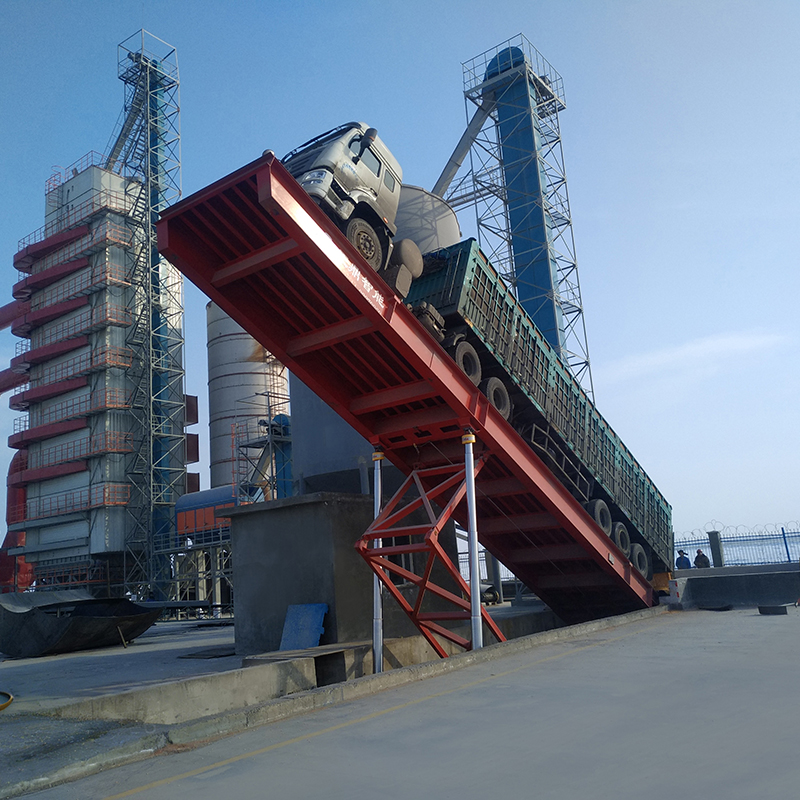 Standard Truck Dumper for Bulk Solids UnloadingThis rear-side truck dumper handles payloads from 30 to 100 tonnes with a tilt angle of 35–40 degrees, making it a reliable choice for free-flowing materials like grain or coal. Its mechanical rigid synchronization system improves stability and safety.View Product →
Manufacturers who build this equipment in-house, such as Jiangsu Zhengding Intelligent Equipment Co., Ltd., control the quality of every structural weld and hydraulic component. This is important because the lifting mechanism carries the combined weight of the truck and its cargo. A platform that flexes during lifting can cause unstable unloading or premature hydraulic seal failure. An established supplier will normally offer CE-certified models, documented load-testing procedures, and a warranty that covers both hydraulic and electrical components.
Side-Turn Truck Dumpers
Side-turn truck dumpers tilt the platform sideways instead of backward. This design is essential when the receiving area has a height restriction behind the truck or when the material must be discharged to a fixed side conveyor. An automatic side-turn truck dumper can handle the same payload range as a rear-side unit while occupying a narrower footprint. It is frequently chosen at facilities where trucks enter from one side and conveyors run along a wall, allowing the layout to remain compact.
Mobile Truck Dumpers
A mobile truck dumper does not require a fixed pit or foundation. The entire platform and hydraulic system are mounted on a trailer or self-propelled chassis. It is ideal for operations that need to serve multiple unloading points with one machine, such as a grain elevator that receives from several locations during harvest season. A mobile unit can be repositioned in a few minutes and runs from a diesel engine or an electric generator. This flexibility makes it popular among wholesalers and distribution centres that handle seasonal influxes.
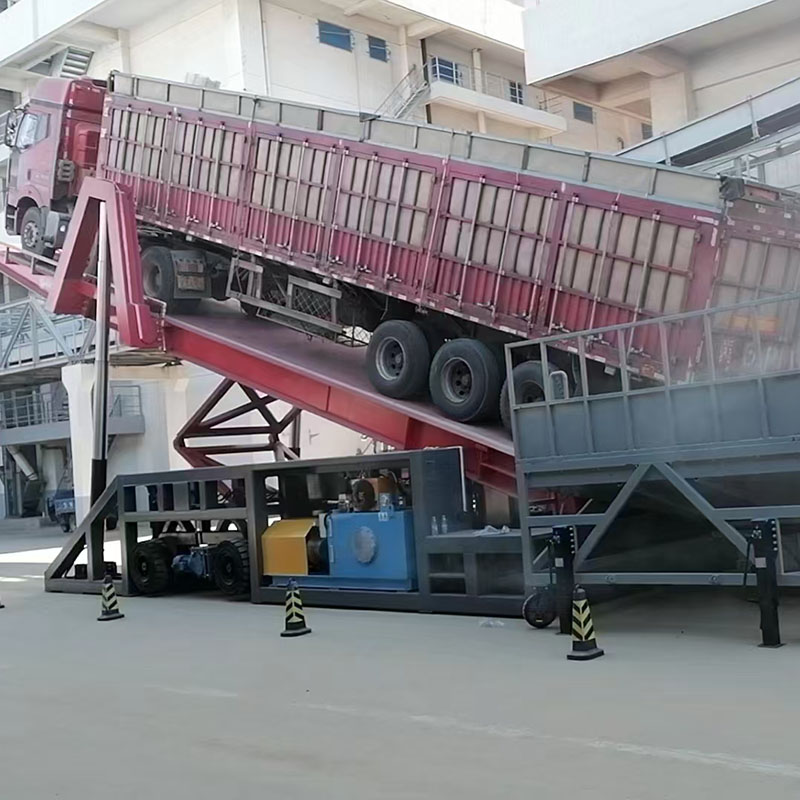 Mobile Truck Dumper with 360-Degree Turning CapabilityDesigned for flexible unloading at multiple points, this mobile unit offers self-propelled or towed movement. Its central drive enables on-the-spot 360-degree turns, and an automatic wheel-fixing device simplifies operation without dust exposure.View Product →
When a manufacturer like Jiangsu Zhengding ships a mobile truck dumper, it typically includes a hydraulic stabilising leg system that lowers before lifting, reducing the ground pressure and preventing tipping. Operators should verify the maximum grade tolerance and the required ground composition before purchasing a mobile system.
Shallow Foundation and Pitless Models
For existing concrete yards or sites with a high water table, a pitless truck dumper is the practical answer. Instead of digging a deep pit, the platform is built on a low-profile steel frame that rises about 0.5 meters above ground. A shallow foundation version reduces excavation depth to about 1.5 meters, balancing installation cost with material access. These models are especially valuable when retrofitting a facility without shutting down surrounding operations.
Enclosed Truck Dumpers with Dust Control
Handling dusty materials such as cement, fly ash, or pulverised lime creates a serious environmental risk. An enclosed truck dumper integrates a full dust extraction hood, flexible sealing curtains, and an optional wet suppression system. The enclosure captures airborne particles before they escape into the work yard. Facilities that need to comply with strict environmental permits will find this configuration a responsible choice. In food applications, the same principle prevents foreign material contamination.
Unattended Truck Dumpers with Integrated Weighing
An unattended truck dumper combines a hydraulic unloading platform with load cells and an automated weighbridge sequence. The driver places the truck on the platform, the system verifies the weight, the lifting sequence runs, and the material is discharged with no operator present. This design is gaining traction in ports and large processing plants that need continuous operation overnight. A typical unit uses four to six load cells with a total accuracy of plus-minus 0.5% or better, depending on the weighing instrumentation chosen.
Container Handling Equipment
Containerised bulk shipping has increased dramatically over the past decade. A container flipping machine rotates an entire 20-ft or 40-ft container up to 180 degrees to empty bulk solids through a top or side door. A continuous container handling system instead moves several containers along a short conveyor or turntable, creating a semi-continuous flow. Both methods eliminate the need for workers to enter the container and manually shovel material, which is both time-consuming and dangerous. A gantry container tilter offers even longer cycles and higher throughput for terminals that handle hundreds of containers per day.
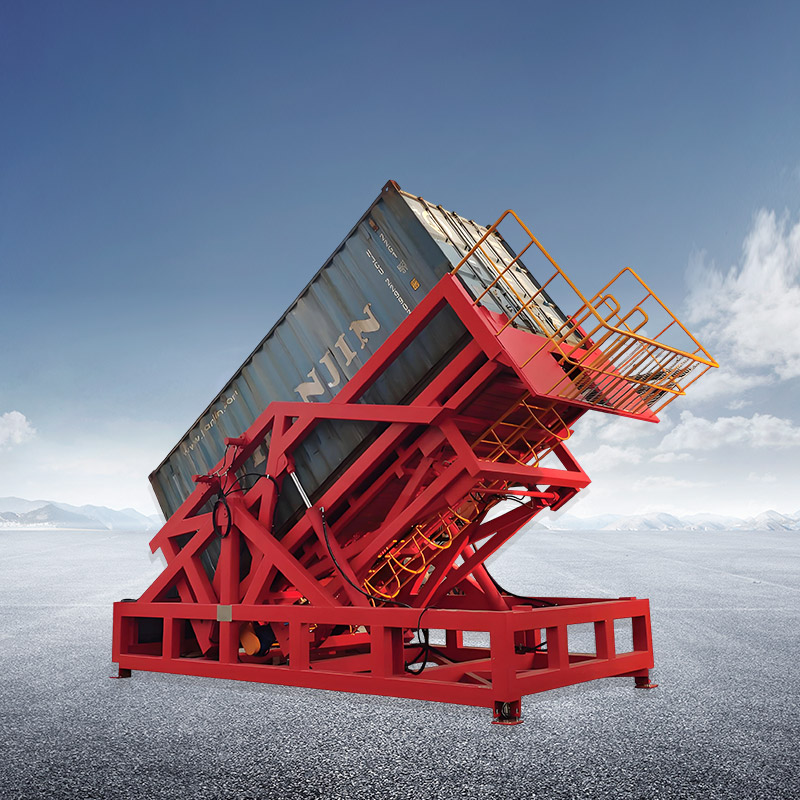 Container Flipping Machine for Efficient Bulk LoadingThis machine flips containers vertically up to 180 degrees, using gravity for fast filling or unloading. With hydraulic balancing and reinforced steel frame, it handles frequent heavy operations while offering optional door automation and weighing.View Product →
Wholesalers who import bulk goods in containers often underestimate the time and labour required to empty them. The actual cost per container-emptying operation typically drops by 70% to 80% when a container flipper is installed, because the unloading time falls from several hours to approximately 20 minutes per container.
Key conclusion: Choose the material handling system type based on your material flow direction, existing yard layout, dust control requirements, and the degree of automation you actually need.
Working Principle and Structural Design of a Material Handling System
The operational reliability of any material handling system depends on four fundamental sub-systems: the platform structure, the hydraulic lifting system, the safety interlock chain, and the control interface. Understanding these elements enables a buyer to evaluate equipment quality on a meaningful level.
Platform Structure and Tilt Geometry
The platform is a welded steel deck with long transverse ribs that prevent flexing under concentrated loads. The structural calculation considers the max axle load and the distribution of material inside the truck. A typical rear-side truck dumper platform is built from high-strength steel plates with a thickness between 8 mm and 20 mm, depending on the designed payload. The tilting pivot is located near the rear axle, and the lift cylinders act on the front half of the deck to raise it to the final angle. For a 40-degree tilt angle, the force at the cylinder can exceed 250 tonnes on a 100-tonne payload system.
Hydraulic Lifting System with Synchronised Cylinders
The hydraulic system is the heart of the dumper. A reputable material handling system manufacturer such as Jiangsu Zhengding uses an original mechanical hydraulic cylinder synchronization system that provides high precision and safety. The principle is that multiple lifting cylinders work together with a positive displacement flow divider or mechanical coupling, so the platform remains level throughout the entire stroke. If one cylinder moves slightly faster, the synchronising valve diverts flow to the slower cylinder, correcting the mismatch within milliseconds.
This synchronisation matters because unequal lifting causes the truck to shift sideways, which can lead to severe tipping and catastrophic failure. The OEM's proprietary design is claimed to deliver a high level of precision and safety, an important claim that a buyer should verify by reviewing factory load tests. For a nominal 60-degree side-turn dumper, the timing tolerance for the two main cylinders is typically kept within 2% of the stroke length.
Safety Interlock and Control Logic
A modern truck dumper uses a PLC or a simple relay control cabinet with status sensors on the platform, the vehicle wheels, and the hydraulic volume. The system will not start lifting unless the parking brake is engaged and the transmission is placed in neutral. An audible and visible warning signals the operator before the deck moves. On a fully enclosed dust-control model, the extraction fan starts automatically when the platform lifts, ensuring that airborne dust is captured at the source. On an unattended weighing model, a light curtain or radar sensor checks that nobody is standing in the danger zone before the cycle begins.
Buffer Hopper Design for Fragile Materials
Certain products are sensitive to impact. A food-grade material handling system for unloading oranges or similar fruits uses a buffer hopper mounted below the discharge edge of the platform. As the tilt angle increases, the fruit drops into the buffer hopper, which cushions the fall, and then flows gently onto a takeaway conveyor. This design, described in the application case of an orange receiving line, prevents the fruit from falling directly from the high platform to the conveyor, significantly reducing bruising and product loss. When considering such a system, discuss the material's drop height, cushioning media, and product contact surface materials with the manufacturer.
Integrating Weighing into the Handling Cycle
An unattended truck dumper with integrated weighing combines load cells, a weight transmitter, and an automatic identification system to create a complete inbound logistics solution. The truck registers at the plant entrance, and the system records the tare weight and the gross weight from a weighbridge. When the truck drives onto the dumper, the load cells measure the net weight of the received material. The system then sends the data to an ERP or warehouse management system, reducing manual data entry and the associated errors. This integration is particularly valuable in grain silos and raw material stockyards where every kilogram has to be accounted for.
Key conclusion: The structural geometry, hydraulic synchronisation quality, and safety interlock design are the three decisive factors that separate a durable material handling system from a problematic installation.
Application Scenarios and Selection Criteria for Material Handling Systems
Different industries place very different demands on a material handling system. A steel plant may need to unload a 90-tonne truck of iron ore at a rate of 500 tonnes per hour, while a food plant might handle only 30 tonnes per day but requires that the equipment never contaminates the product. The selection process must balance throughput, material characteristics, site constraints, and budget. Below, we look at the main application sectors and the critical selection points for each.
Steel and Metallurgy
In the steel industry, trucks deliver iron ore, limestone, coke breeze, and steel slag. These materials are abrasive and heavy. The ideal system is a heavy-duty rear-side or side-turn truck dumper with hardened wear plates on the platform and a high-tonnage hydraulics package. The equipment must tolerate a harsh environment with high dust and temperature variance. Many plants install the dumper directly under a dust extraction canopy, protecting the equipment and the surrounding area.
Chemical and Fertilizer
Chemical plants handle ammonium nitrate, urea, potash, and various acids or alkalis in solid form. The primary risk is corrosion of the platform and hydraulic lines. Stainless steel or epoxy-coated platforms may be required depending on the product. In addition, chemical facilities often need a fully enclosed dumper with filtered air to comply with hazardous-dust regulations. The equipment must have ATEX-compliant or explosion-proof electrical components for certain gases or dusts.
Cement and Construction Materials
Cement, clinker, and limestone are extremely dusty, so a sealed dust-control system is almost mandatory. The material also has high bulk density and can pack tightly during transport. A side-turn dumper is often used in cement plants because it discharges directly into a feed hopper along a wall, allowing a compact layout. The platform is designed with a steep tilt angle of up to 47 degrees or more to ensure complete discharge of cohesive materials.
Coal and Energy
Coal-fired power plants and coking plants rely on fast truck unloading to feed their boilers around the clock. A pitless or shallow foundation design is common because the receiving areas are usually large and the ground water level might be high. An integrated weighbridge helps reconcile fuel deliveries with the plant's mass balance. For especially dusty coal, an enclosed model with a bag filter or wet scrubber is the appropriate solution.
Grain, Oil, and Food
In the food and feed sector, the material handling system must meet hygienic design principles. The platform surface should have no pockets where grain or flour can accumulate. Food-grade equipment typically uses food-safe hydraulic oils and optional stainless steel surfaces. A buffer hopper arrangement is beneficial for fragile products such as breakfast cereal or fruit. Grain elevators often combine an unattended truck dumper with an automatic hopper scale so that incoming loads are weighed and logged without operator intervention.
Container-Based Logistics
For bulk goods shipped in containers, the handling system must change from a truck dumper to a container flipper. The selection criteria include container type (20-ft or 40-ft), maximum loaded weight, and the need to treat multiple containers per hour. A gantry container tilter can process 12 to 20 containers per hour, which is suitable for port operators. A simple container flipping machine may be the right choice for a single-dock facility handling a few containers per day.
When selecting a system, always validate five critical parameters before requesting a quotation. First, the maximum truck length and total weight. Second, the cargo's bulk density, angle of repose, and flowability. Third, the available space and the allowable foundation depth. Fourth, the required throughput in tonnes per hour. Fifth, the environmental and safety requirements such as dust limits and personnel access restrictions.
A useful format for comparing these requirements across departments is to create a two-column checklist that lists each criterion and its target value. The following template helps a procurement team summarise the major decision points:
| Criterion | Target Value or Constraint |
|---|---|
| Max truck payload | 40 t, 60 t, 80 t or 100 t depending on fleet |
| Daily truck count | 20 to 150 trucks per shift |
| Available foundation depth | 0 m (pitless), 1.5 m (shallow) or 3 m (full pit) |
| Dust control requirement | Enclosed unit with extraction or open-air system |
| Weighing integration | Required or not required |
| Unloading angle | Rear-side 35 to 40 degrees, side-turn 45 to 55 degrees |
Purchasing managers frequently ask whether they should buy from a manufacturer directly or go through a trading company. A material handling system manufacturer that produces its own hydraulic cylinders, platforms, and control cabinets can be held accountable for every component. A trading company may offer a slightly lower price but often cannot provide the same level of technical support or spare parts inventory. For a critical piece of equipment that operates every day, the reliability of the supplier is just as important as the technical spec.
Key conclusion: The most reliable selection process in a material handling system project begins with carefully defined payload, material flowability, and site constraints, then moves to comparing manufacturers on technical performance, not just price.
Detailed Comparison of Common Material Handling Systems
Choosing between a rear-side truck dumper and a side-turn truck dumper is one of the most common decisions in bulk material handling procurement. Both machines serve the same primary function, but their operational differences affect layout, safety, and cost. The following comparison table summarises these differences and helps a plant engineer decide which approach fits the site.
| Criteria | Rear-Side Truck Dumper | Side-Turn Truck Dumper |
|---|---|---|
| Tilting direction | Backward, along the truck length | Sideways, perpendicular to the truck length |
| Typical max angle | 35-40 degrees | 45-55 degrees |
| Space required behind | Needs space for the tailgate area | Needs side space for a hopper or conveyor |
| Best material | Free-flowing, granular | Sticky or cohesive materials needing higher angle |
| Footprint | Longer along the vehicle direction | Narrower along the vehicle direction |
| Installation depth | Generally pit or shallow pit | Can be pitless or shallow foundation |
| Example application | Grain elevator, cement yard | Cement plant, coal-fired power plant |
Another comparison that influences capital cost is the foundation type. A full pit installation requires extensive civil work, including excavation, waterproofing, and concrete pouring. A shallow foundation reduces that work but requires a longer delivery time because the platform is built with a more complex steel frame. Pitless models offer the lowest installation cost, but the raised platform needs a ramp or a ground-level approach, which consumes a little more yard space. The following table compares these in practical terms:
| Foundation Type | Civil Work | Installation Time | Prominent Advantages |
|---|---|---|---|
| Full pit | Excavation and waterproofing | 3 to 5 weeks | Lowest platform height, best access for trucks |
| Shallow foundation | Moderate excavation about 1.5 m deep | 2 to 3 weeks | Reduced excavation cost, still a low approach angle |
| Pitless | Ring beam or slab foundation only | 1 to 2 weeks | No deep pit, ideal for retrofits, least civil cost |
Mobile truck dumpers bring a completely different logic. They are not tied to one spot and can be moved between unloading bays. A mobile unit is usually more expensive per unit of capacity than a fixed pit installation, but if the facility has multiple receiving points or expects to relocate the equipment, the lower total cost of ownership can be substantial. A fixed unit is the best choice for a high-volume, permanent receiving point.
For container handling, the comparison centres on the device type. A standard container flipping machine is the simplest structure, rotating a single container about its longitudinal axis. It handles one container at a time and typically completes an unloading cycle within 15 to 25 minutes. A continuous container handling system adds a short turntable or a powered roller system, allowing the operator to stage the next container while the first one is being emptied, raising the throughput to 12 to 20 containers per hour. A gantry container tilter uses an overhead gantry to lift the container and tilt it, producing the highest throughput but at a higher capital cost.
| Equipment Type | Containers per Hour | Investment Level | Best Use Scenario |
|---|---|---|---|
| Container flipping machine | 3 to 5 | Low-to-medium | Single dock, low to moderate daily throughput |
| Continuous container handling system | 12 to 15 | Medium-to-high | Dedicated receiving terminal with multiple daily loads |
| Gantry container tilter | 15 to 20 | High | Port, large warehouse, or high-volume import facility |
The choice between automatic and manual operation also has a direct effect on staffing. A conventional truck dumper requires an operator who controls the platform from a nearby panel. An unattended system replaces that person with a sequence controller, a card reader or a truck licence plate recognition camera, and a set of safety light curtains. The payback period of the additional automation investment is often less than two years for a facility that receives more than 60 trucks per day.
Key conclusion: The correct equipment choice emerges from matching the material's flow characteristics with the plant layout and then comparing the total cost of ownership across foundation options, automation levels, and container handling capacities.
Material Handling System Industry Adoption Distribution Analysis
To understand the market demand for material handling systems, we analysed the adoption distribution across major industries using data from field reports, publicly available case studies, and equipment deployment records from Chinese and international plants. The analysis focuses on which sectors have the highest share of installed systems and therefore benefit most from automation. This information helps you see where the practical demand is concentrated and how the trend may influence your own procurement planning.
The data set covers approximately 300 recent installations of truck dumpers, side-turn dumpers, and container handling equipment in Asia, Europe, and South America. The results are not a perfect global census, but they reflect the current industrial pattern well enough to guide a first investment conversation. Each industry has its own drivers, and the bars below show the percentage of surveyed plants in that sector that use at least one automated unloading device.
It is worth noting that the percentages are relative to the total number of installations in each sector, not the absolute number of plants in the region. For example, steel and cement are both heavy users, but the steel industry has a slightly higher penetration rate because the raw material volumes are so large. The chart also reveals where the growth is likely to be strongest.
When a plant manager reviews these numbers, the relevant question is not which industry ranks highest, but whether the equipment adoption in their own sector is already widespread. If a competitor in the same industry has already adopted automation, the competitive pressure to follow is significant.
This analysis helps a buyer understand that a material handling system investment is a common, mature decision rather than an experimental adaptation. The equipment is a standard, proven part of industrial logistics.
The chart clearly shows that the steel industry leads with a 92% adoption rate among surveyed plants. This high penetration is directly linked to the enormous daily tonnage arriving by truck and the pressure to maintain a continuous, predictable raw material feed to blast furnaces or direct reduction plants. At a steel site, a truck waiting an extra hour often triggers a production delay, so the economic justification for automation is immediate and calculation-ready.
Chemical plants follow closely at 85%. The reason is not only efficiency but also safety. Many chemical raw materials are hazardous if handled manually, and dust extraction systems are integrated into the dumper to protect workers. A chemical plant often receives a wide range of different materials, and the flexible, enclosed design of modern handling systems addresses that variety effectively.
Grain and oil processing are shown with adoption rates of 81% and 76%. These sectors have historically led the adoption of truck dumpers because grain is a relatively easy product to handle in bulk, and the main challenge is simply the huge volume arriving during the harvest season. An unattended weighing dumper is particularly common in grain elevators because it combines unloading and weighing in one operation, reducing administrative overhead.
Cement and coal rank at 78% and 74%, respectively. Both industries face distinct practical obstacles, such as extreme dust and the need to handle cohesive materials. The lower rate compared to steel might reflect the fact that some smaller cement plants still rely on manual or semi-manual unloading due to the shorter seasonal production window. However, the trend clearly points toward greater automation, with new environmental regulations pushing many plants to adopt enclosed dust-controlled systems.
Food processing shows the lowest adoption rate at 69%, but it is the fastest-growing segment in the survey. As food manufacturers aim to improve hygiene standards, reduce manual handling, and achieve traceability, the demand is rising quickly. A food-grade dumpers with a buffer hopper and stainless steel contact surfaces is now a practical and commercially attractive option for many fruit and vegetable processing lines. The growth potential here is significant.
The adoption percentages also correlate with the average truck payload in each sector. Higher payloads tend to encourage automation because the manual handling cost is more compelling. This means that if your facility receives heavy trucks with a large daily count, the business case for automation is stronger. The data confirms that the equipment is a standard industrial solution that has proven itself across very different operational environments.
Key conclusion: The industries that rely on large, frequent bulk deliveries have widely adopted material handling systems, and rising labour costs plus environmental regulation will continue to push the remaining low-adoption segments toward automation.
Maintenance and Operational Guidance for Material Handling Systems
Once a reliable hydraulic dumper is installed, its performance over the long term depends entirely on a scheduled maintenance programme. Even a well-built machine will fail prematurely if the hydraulic fluid becomes contaminated, the moving parts are not lubricated, or the safety interlocks are bypassed. A disciplined maintenance routine protects the investment and prevents costly downtime.
Daily Inspection Checklist
Operators should begin each shift with a walk-around inspection that takes no more than five minutes. Check the hydraulic oil level through the sight glass, watch for visible external leakage on the cylinders and piping, inspect the platform surface for cracks or loose bolts, verify that the limit switches move freely, and test the emergency stop button. On an enclosed dust-control model, listen for unusual fan noise and check the filter differential pressure gauge.
Hydraulic Oil and Filter Maintenance
The hydraulic oil in a truck dumper should be sampled and analysed at least once a year. If the oil contains more than 2,000 milligrams per litre of coarse particles or shows a change in viscosity, it should be replaced immediately. Most manufacturers recommend a full oil change after the first 200 operating hours, then every 2,000 to 3,000 hours, depending on the operating environment. The return line filter should be replaced at the same interval or when the pressure differential indicates clogging.
High-quality hydraulic oil is particularly critical. The synchronized cylinder system used by the manufacturer depends on a consistent fluid viscosity across the operating temperature range. If the oil thins out too much, the accuracy of the mechanical synchronization can be affected. Pay attention to the recommended oil grade: ISO VG 32 is common for moderate climates, while ISO VG 46 is often selected for warmer tropical or subtropical installations.
Lubrication of Pivot Points and Rollers
The platform pivot points, the cylinder rod eyes, and the support rollers on the foundation guide rails require regular grease. Most manufacturers specify a lithium-based grease applied every 200 hours or once a week. On units exposed to heavy dust or moisture, more frequent greasing may be necessary. Automatic lubrication systems are available for facilities that want to eliminate the risk of oversight.
Safety Interlock Verification
A dangerous failure mode in any dumper is a malfunction of the safety interlock. When a truck dumper is used in an unattended mode, the protection system must be tested more frequently. Check that the platform cannot be lifted when the wheel chocks are not in place and that the emergency stop circuit immediately halts the pump. Confirm, at least once a month, that no operator can reach the lifting zone through an unguarded area.
Electrical and Control Cabinet Maintenance
Dusty environments can overload a control cabinet, causing relays to stick and sensors to give erratic readings. The cabinet should be blown out with dry compressed air every month and checked for signs of moisture. All cable glands should stay sealed, and the door seal should be replaced if it shows wear. The PLC battery, where present, needs replacement every two to three years.
Common Troubleshooting Guide
If a truck dumper moves slowly or hesitates during lifting, the most likely causes are low hydraulic oil level, a clogged suction filter, or air entering the hydraulic system. If one side of the platform arrives behind the other, the synchronization valve may need adjustment or a cylinder might have an internal seal by-pass. An unusual whining sound from the pump often indicates aeration or a worn pump element. The guide below lists frequent problems and their typical remedies.
| Symptom | Likely Root Cause | Corrective Action |
|---|---|---|
| Low lifting speed | Oil level low or filter clogged | Top up hydraulic oil; replace suction filter |
| Asymmetrical lift | Synchronising valve out of tolerance | Re-calibrate valve or call manufacturer service |
| External oil leak | Worn hydraulic seal | Replace cylinder seal kit |
| Excessive noise from pump | Air in the circuit or worn pump | Bleed the system; replace pump if worn |
| Dust extraction does not start | Fan motor overload or limit switch fault | Inspect motor and sensor; replace faulty part |
For additional guidance on maintaining container handling equipment and side-turn dumpers, operators can refer to the manufacturer's specific maintenance articles. These documents provide step-by-step instructions that are directly written for the machines in this material handling product range.
Key conclusion: The majority of premature material handling system failures are caused by contaminated hydraulic oil, neglected lubrication, or bypassed safety devices. A system-specific maintenance schedule is the cheapest insurance available.
FAQ - Material Handling Systems
What is a material handling system, and what types are available?A material handling system covers all equipment and processes that move, store, and control materials within a facility. In bulk material handling, the most common systems are hydraulic truck dumpers, side-turn truck dumpers, mobile truck dumpers, pitless and shallow foundation models, enclosed dust-controlled dumpers, unattended weighing dumpers, and container flipping or handling systems. Each type is designed for a specific material flow pattern and operating constraint. |
How do I choose the right material handling system for my application?Start by defining your maximum payload and truck dimensions, your material flowability, your required throughput, and your available foundation depth. Then decide whether you need an enclosed dust control system, integrated weighing, or automation. Compare manufacturers on their engineering experience, actual installed references, safety features, and after-sales support. A supplier that manufactures its own major components, such as Jiangsu Zhengding Intelligent Equipment, is generally a safer choice than an assembly-only trading company. |
What is a typical unloading angle for hydraulic truck dumpers?Rear-side truck dumpers usually operate at a maximum tilt angle of 35 to 40 degrees, depending on the material's angle of repose. Side-turn truck dumpers can reach 45 to 55 degrees because they need to achieve complete discharge from sticky or cohesive materials. A steeper angle is always better for materials that clump, but it also exerts more force on the truck and the platform structure, so the choice must be verified by the manufacturer. |
Can a material handling system be integrated into an existing facility?Yes. A pitless or shallow foundation truck dumper is specifically designed for retrofits into existing yards with minimal civil work. Mobile truck dumpers can also serve a facility that lacks a fixed loading bay. Before making a decision, a site survey is necessary to determine the ground bearing capacity, the available turning radius for trucks, and the position of any underground ducts or cables. |
Is an unattended truck dumper with integrated weighing safe to operate?Yes, an unattended truck dumper is designed with multiple safety interlocks, including wheel chock detection, light curtains, a platform edge guard, and an emergency stop circuit. The weighing system uses industrial load cells with a high safety factor. The sequence controller verifies that no person is in the danger zone before the lifting cycle can start. It is important to maintain and test these safety devices regularly. |
What should I consider when buying a material handling system from a manufacturer in China?Check whether the supplier is a real manufacturer with its own production facility, not just a trading company. Ask for references from the same industry. Verify the equipment CE certification, load tests, and warranty terms. Discuss spare parts availability and the response time for international service. A manufacturer such as Jiangsu Zhengding Intelligent Equipment offers a complete range from truck dumpers to container handling equipment, meaning you can source most of your material handling needs from one reliable supplier. |
Key conclusion: A material handling system is not a commodity purchase. It should be evaluated against the long-term safety, maintenance, and integration needs of your specific site, not merely the initial purchase price.
Explore More About Material Handling Solutions
The material handling system topics discussed above are just the starting point. To dive deeper into specific equipment categories and practical maintenance guidance, explore the following resource links. These pages offer detailed product information, technical comparisons, and hands-on advice that is directly relevant to plant operators, maintenance teams, and procurement managers.
Truck Dumpers
Browse the complete range of rear-side, mobile, pitless, and enclosed truck dumpers.
View overviewContainer Handling
Explore container flipping machines, loaders, and continuous handling systems.
View equipmentMaintenance Tips
Learn how to keep container loading equipment efficient and safe.
Read maintenance guideIndustry Applications
See real examples of truck dumpers in steel, food, and grain industries.
Read case overviewEach product page contains downloadable specifications, layout drawings, and configuration options. If you want to compare side-turn dumpers or read about the latest technical developments, use the navigation on the manufacturer's website. The right material handling system brings immediate, measurable results to any bulk material receiver.
Key conclusion: Start with a clear assessment of your current unloading pain, then compare the detailed technical documentation and maintenance guidance from a manufacturer that supports you for the entire service life of the equipment.


