

 English
 русский
 Español
 Français
 Português
 عربى
عربى



+86-13588556918
Content
- 1 What Makes a Truck Dumper Reliable for Bulk Unloading Operations
- 2 What Is a Truck Dumper and How Does It Work
- 3 Mechanical Rigid Synchronization vs Traditional Oil-Flow Control
- 4 Core Safety and Automation Features
- 5 Feature Profile: Balancing Safety, Precision and Automation
- 6 Typical Industries and Applications
- 7 Automation Level: Reducing Manual Operator Involvement
- 8 Product Structure and Technical Reference Diagram
- 9 Choosing Between New and Used Truck Dumpers
- 10 Related Equipment Categories: Wheel Dumpers, Dumper Trailers and Landfill Tippers
- 11 Maintenance and Long-Term Reliability Considerations
- 12 Industry Trends in Automated Loading and Unloading Equipment
- 13 Selecting the Right Truck Dumper Configuration for Your Site
- 14 About Jiangsu Zhengding Intelligent Equipment Co., Ltd.
- 15 Frequently Asked Questions
What Makes a Truck Dumper Reliable for Bulk Unloading Operations
The direct answer is that reliability in a truck dumper comes primarily from how the side cylinders are synchronized during the tipping motion, since uneven cylinder movement is the leading cause of structural stress, vehicle instability and premature component wear in bulk unloading equipment. A mechanical rigid synchronization mechanism, which physically links the movement of both side cylinders rather than relying solely on controlling oil flow rate, produces a simpler structure with fewer points of failure and more predictable operation compared with hydraulic flow-based synchronization alone. This distinction is the central factor buyers researching truck dumpers for sale, used truck dumpers, or wheel dumpers should evaluate before comparing any other feature.
This article examines the engineering reasoning behind that conclusion, covering synchronization methods, safety automation, typical industry applications, structural components and long-term maintenance considerations for truck dumpers, truck tippers, dumper trailers and related landfill tipper equipment used in bulk material handling.
What Is a Truck Dumper and How Does It Work
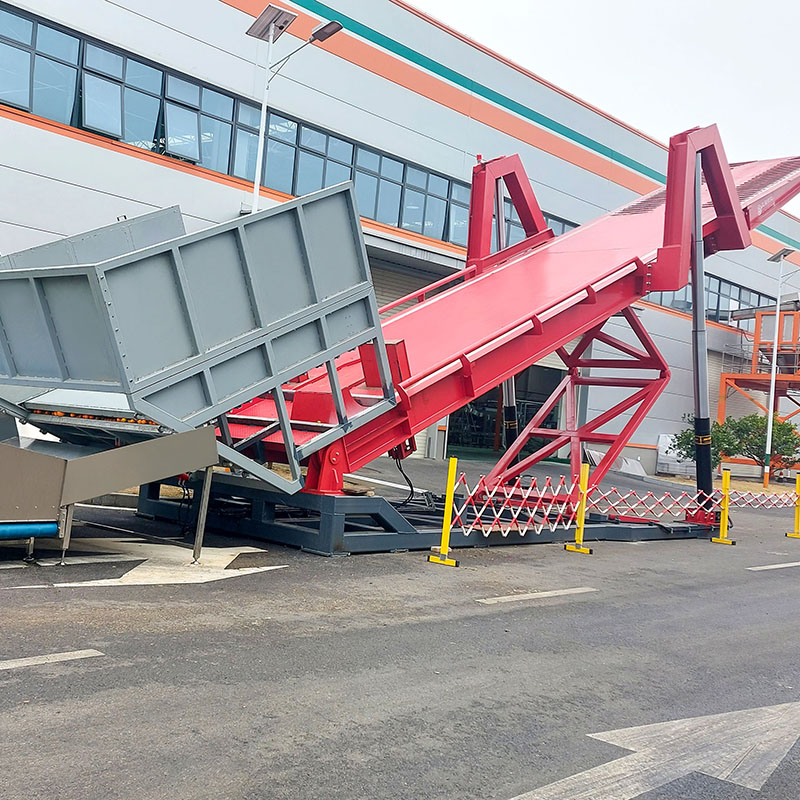
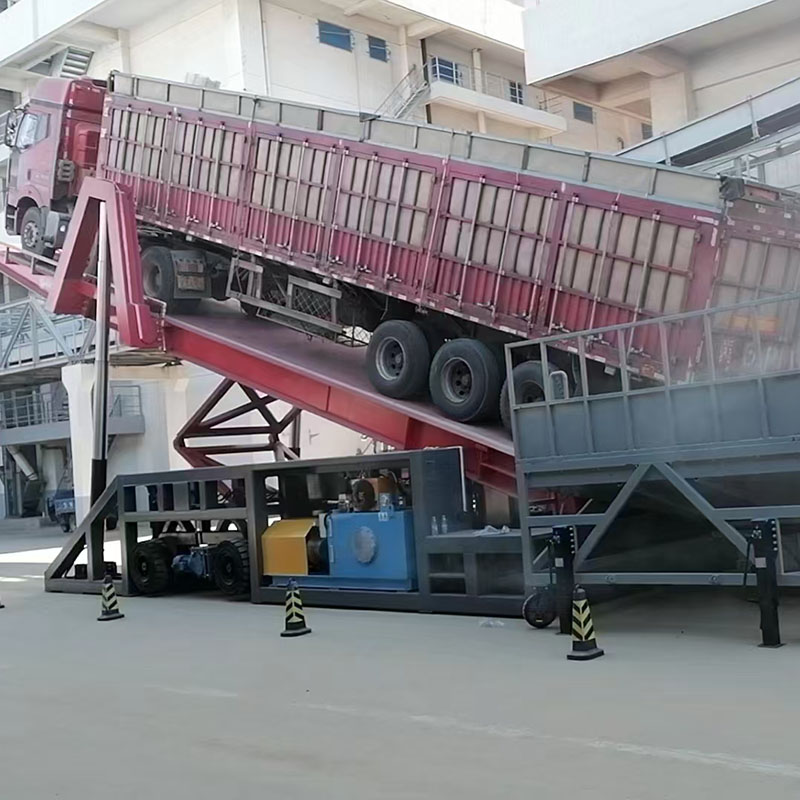
A truck dumper, also referred to as a truck tipper, is a heavy-duty piece of loading and unloading equipment that lifts one end of a loaded truck or trailer to a steep angle so that bulk material inside the cargo bed slides out under gravity. This approach is widely used across industries that move large volumes of loose material, including grain, coal, ore, chemicals and construction aggregate, because it avoids the labor and time cost of manual unloading. The truck is driven onto a platform, secured, and then the platform is raised hydraulically using side cylinders positioned along the length of the ramp structure.
Why Cylinder Synchronization Is the Core Engineering Challenge
Because the platform is lifted by two or more side cylinders working in parallel, any difference in the speed or extension of those cylinders causes the platform to tilt sideways rather than rise evenly, which places uneven load on the structure and on the vehicle resting on it. Traditional truck dumpers address this by controlling oil flow rate to each cylinder, attempting to keep both sides moving at a matched speed. According to widely referenced hydraulic engineering literature on synchronous lifting systems, flow-control synchronization is inherently sensitive to changes in load distribution, seal wear and oil temperature, all of which can introduce timing drift between cylinders over repeated cycles.
Mechanical Rigid Synchronization vs Traditional Oil-Flow Control
The chart below presents a qualitative comparison between traditional oil-flow-controlled synchronization and a mechanical rigid synchronization mechanism across four dimensions relevant to truck dumper reliability: structural simplicity, operational precision, vibration during operation, and long-term cylinder wear. These ratings reflect a general qualitative assessment based on the structural design principles described in this article, rather than a standardized third-party laboratory benchmark, and are intended to illustrate the relative direction of improvement rather than exact measured values.
Several conclusions follow from this comparison. Mechanical rigid synchronization achieves higher structural simplicity because it removes dependence on precisely matched flow-control valves, replacing an electronically or hydraulically managed timing relationship with a physical linkage that inherently keeps both sides aligned. Operational precision improves because the tipping motion follows a fixed mechanical relationship rather than a variable that can drift with oil temperature or seal condition. Vibration during operation is reduced because a rigid link limits the degree to which one side can lag behind the other under load. Long-term cylinder wear benefits from more even load sharing, since a cylinder that is not forced to compensate for a lagging partner experiences steadier stress across repeated tipping cycles. Together, these factors are the basis for describing a mechanical rigid synchronization system as offering a simpler structure, superior operational reliability and enhanced safety compared with oil-flow-only control.
Core Safety and Automation Features
Beyond cylinder synchronization, several supporting features determine how safely and consistently a truck dumper performs across daily operations. These features are particularly relevant for buyers comparing truck tippers intended for continuous industrial use rather than occasional or light-duty applications.
- High-precision oil cylinder synchronous stability system is engineered to maintain safety with reduced vibration during operation, limiting impact on the cylinders and extending their service life.
- Full automatic retaining wheel fixing device secures the truck wheels without requiring an operator to stand near the platform holding a remote control in a dusty environment, which simplifies the process and improves operator safety.
- Imported oil cylinders and pumps are used to support safe, reliable operation and a longer service life for the core hydraulic components.
- Unmanned control capability allows the driver to complete the unloading operation independently, without requiring a dedicated professional operator to manage the equipment.
Together, these features move a truck dumper closer to a fully automated loading and unloading process, reducing the number of personnel required near heavy equipment during operation and lowering the exposure of staff to dust, noise and mechanical hazards typically associated with bulk unloading sites.
Feature Profile: Balancing Safety, Precision and Automation
The radar chart below presents a qualitative feature profile across six dimensions relevant to a modern truck dumper: synchronization precision, operational safety, automation level, component longevity, structural simplicity and maintenance ease. These ratings reflect a general qualitative assessment of the design characteristics described earlier in this article rather than a standardized certification score.
This feature profile shows a design that scores strongly on synchronization precision and operational safety, given the mechanical rigid synchronization mechanism and the full automatic retaining wheel fixing device discussed earlier. Automation level benefits from unmanned control capability, which allows the driver to manage the process without a dedicated operator standing near the platform. Component longevity is supported by the use of imported oil cylinders and pumps combined with more even load sharing during tipping. Structural simplicity follows directly from replacing a flow-control-only synchronization approach with a rigid mechanical link, reducing the number of components that must be precisely calibrated. Maintenance ease benefits from a simpler structure overall, since fewer calibrated components generally translate into fewer routine adjustment points during scheduled servicing.
Typical Industries and Applications
Truck dumpers and related truck tipper equipment are used across a range of bulk material handling industries, each with different unloading volume and material handling requirements. The donut chart below presents an illustrative distribution of the primary industries commonly served by this equipment category, based on the application areas described for this product line. The proportions are illustrative rather than a measured market share study, and are intended to communicate the general breadth of applicable industries rather than precise percentage figures.
This distribution illustrates why truck dumpers are frequently searched together with terms such as wheel dumpers and dumper trailer, since buyers across these varied sectors are often comparing equipment configurations suited to their specific material type. Steel and cement industries typically move dense, abrasive materials that place higher demands on structural durability and platform wear resistance. Chemical and food industries often prioritize contamination control and precise, controlled tipping to protect product integrity. Grain and oil handling frequently emphasizes throughput speed and dust control during unloading. Coal handling operations tend to prioritize continuous-duty reliability given high unloading volumes. Because a single truck dumper platform can often be configured or selected to suit several of these material types, equipment buyers researching truck dumpers for sale frequently evaluate cylinder synchronization and automation features described earlier in this article before finalizing a purchase decision.
Automation Level: Reducing Manual Operator Involvement
The gauge chart below illustrates the relative reduction in manual operator involvement achieved through the combination of the full automatic retaining wheel fixing device and unmanned control capability described earlier. This is a qualitative illustration of automation contribution rather than a certified efficiency measurement, and actual operator time saved will vary by site layout, truck volume and existing operating procedures.
This illustration reflects several practical points about automation in modern truck tipper operation. The full automatic retaining wheel fixing device removes the need for an operator to physically approach the platform to secure the truck, which is one of the more time-consuming and dust-exposed steps in a conventional unloading sequence. Unmanned control capability further reduces dependence on a dedicated, specially trained operator, allowing the driver who delivered the load to also manage the tipping process. This combination is particularly relevant for sites handling high daily truck volumes, where reducing the number of manual steps per cycle has a compounding effect on total site throughput. It is also relevant for sites in dusty or otherwise harsh environments, since fewer required manual interactions with the equipment translate into reduced operator exposure to those conditions. As automated loading and unloading systems continue to be adopted across bulk handling industries, this shift toward reduced manual involvement is a consistent theme across the sector.
Product Structure and Technical Reference Diagram
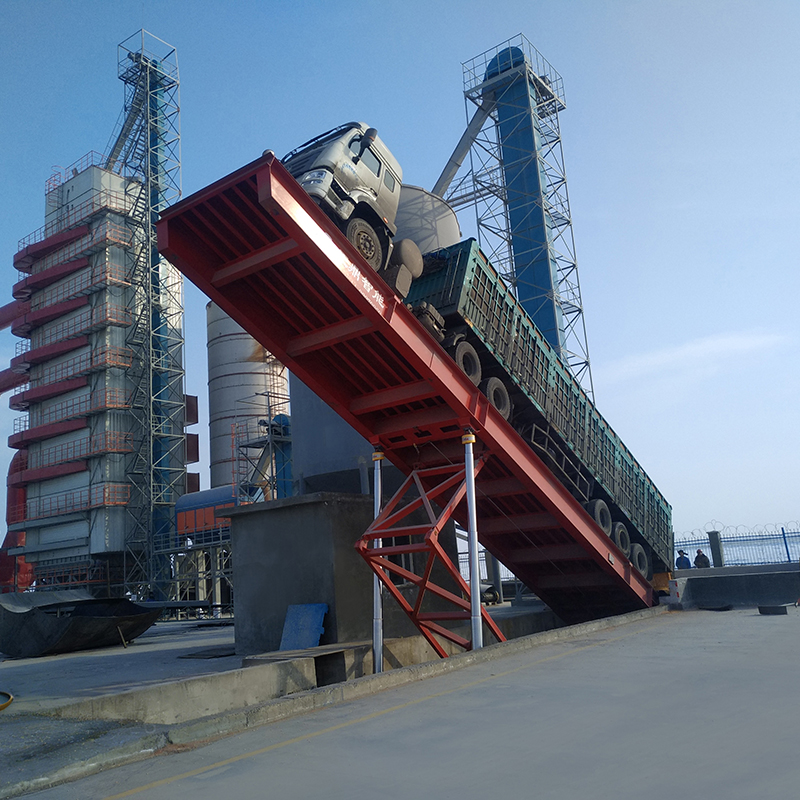
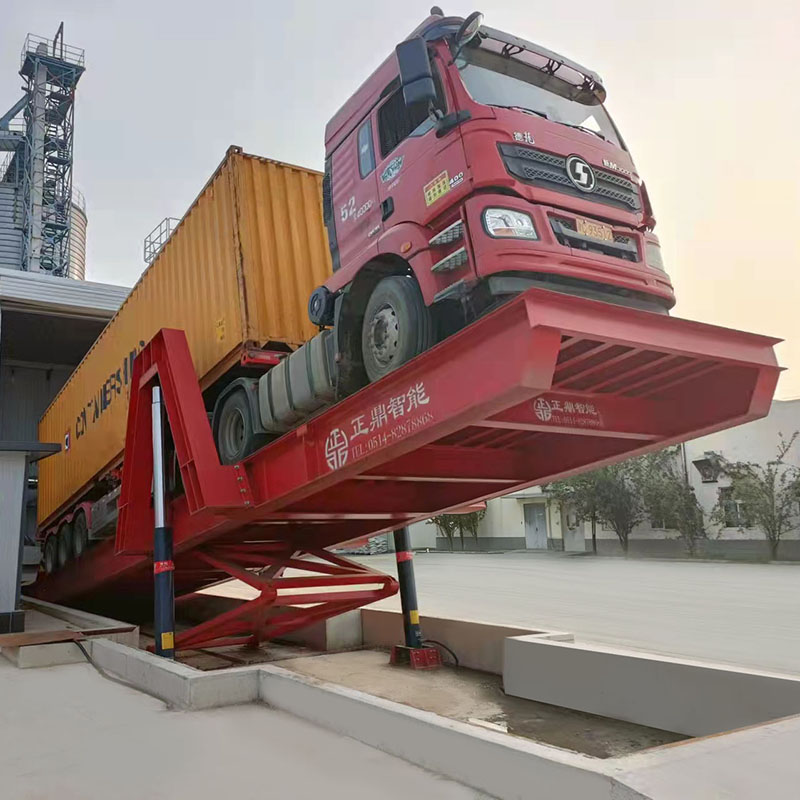
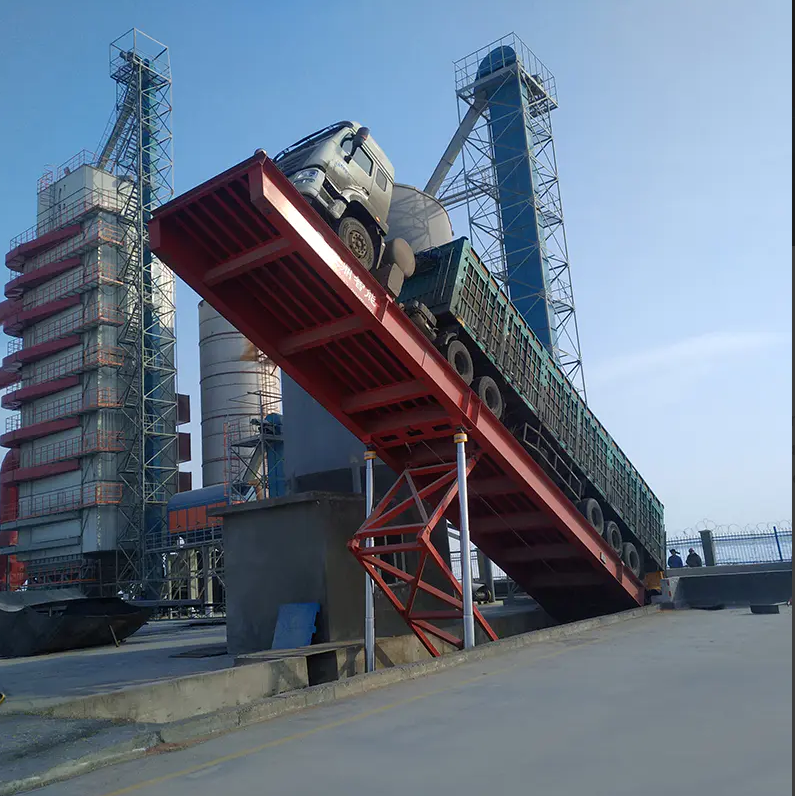
The photograph below shows a truck dumper in operation, with a loaded truck raised on the platform during the tipping sequence. This provides a real-world reference for the structural components discussed throughout this article.
The isometric diagram below labels the primary structural components referenced throughout this article, providing a visual reference for how the platform, side cylinders and support structure work together during the tipping sequence.
The following table summarizes the primary functional components and their role within the overall truck dumper structure.
| Component | Function |
|---|---|
| Side cylinders | Provide the lifting force that raises the platform during the tipping sequence |
| Rigid synchronization linkage | Mechanically links cylinder movement to keep both sides rising evenly |
| Platform ramp | Supports the truck and provides the inclined surface for material discharge |
| Automatic wheel fixing device | Secures the truck wheels automatically without close operator involvement |
| Support legs and base frame | Anchor the structure and distribute load to the foundation during operation |
Choosing Between New and Used Truck Dumpers
Buyers searching for used truck dumpers alongside new equipment listings are typically weighing available budget against the operational risks associated with an already-cycled hydraulic system. Because the reliability of a truck dumper depends heavily on cylinder synchronization, a used unit should be evaluated specifically for signs of uneven wear between the two side cylinders, since this is the clearest indicator of accumulated synchronization drift under a flow-control-only design.
Evaluation Points for Used Equipment
- Check for visible side-to-side tilt during a test tipping cycle, which can indicate synchronization drift between cylinders.
- Inspect cylinder seals and rod surfaces for uneven wear patterns between the two sides of the platform.
- Confirm the retaining wheel fixing device engages and releases consistently across several test cycles.
- Verify the pump and hydraulic lines for leaks or corrosion, particularly on units that have operated in coastal or high-humidity environments.
- Review maintenance records where available to understand the historical service interval and any prior component replacements.
For buyers prioritizing long-term reliability over initial cost, a truck dumper built around a mechanical rigid synchronization mechanism generally presents fewer of these wear-related risk factors over time, since the synchronization method itself is less dependent on precisely maintained flow-control valves that can drift as a unit ages.
Related Equipment Categories: Wheel Dumpers, Dumper Trailers and Landfill Tippers
Buyers researching truck dumpers frequently encounter several related equipment categories during their search, and understanding the distinctions helps clarify which configuration best fits a given application. Wheel dumpers typically refer to platform-style truck tippers that secure and lift the vehicle by its wheels, similar in principle to the wheel fixing device described earlier in this article, and are commonly used where vehicles of varying sizes need to be accommodated on the same platform. Dumper trailers, by contrast, generally refer to towable trailer units with a self-contained tipping bed, suited to lower-volume or mobile unloading needs rather than fixed-site high-throughput operations.
Landfill tipper equipment, including used landfill tipper units sometimes sought by waste management operators, serves a related but distinct function, typically supporting the controlled discharge of waste material at disposal or transfer sites rather than industrial bulk commodity unloading. A concrete dumper, meanwhile, is generally purpose-built or configured to handle the specific discharge characteristics of concrete or aggregate material, which can differ from grain, coal or chemical bulk handling in terms of discharge speed and platform wear resistance requirements. Understanding these distinctions helps buyers match search terms such as truck dumpers for sale or truck tippers to the equipment configuration that actually fits their material handling needs, rather than assuming all bulk unloading equipment operates identically.
Maintenance and Long-Term Reliability Considerations
Consistent maintenance practices extend the working life of a truck dumper and help preserve the reliability advantages associated with a mechanical rigid synchronization design. The following routines are relevant to sites operating this equipment on a regular basis.
- Inspect the rigid synchronization linkage periodically for wear at pivot points, since these connections carry mechanical load throughout every tipping cycle.
- Monitor hydraulic fluid condition and change intervals for the imported oil cylinders and pumps to preserve their rated service life.
- Test the automatic retaining wheel fixing device regularly to confirm consistent engagement across varying truck sizes.
- Clean the platform ramp surface to remove accumulated material residue, which can affect both discharge efficiency and structural inspection visibility.
- Keep unmanned control system software and sensors updated according to the equipment manufacturer's recommended schedule.
Following a structured maintenance schedule helps preserve both the safety and operational precision that a mechanical rigid synchronization system is designed to provide, and reduces the likelihood of the uneven cylinder wear patterns discussed in the used equipment evaluation section above.
Industry Trends in Automated Loading and Unloading Equipment
The broader logistics and bulk material handling sector has continued to move toward automated loading and unloading systems, reducing manual labor requirements and improving consistency across high-volume operations. Trade coverage of industrial logistics equipment has noted growing interest in unmanned or semi-automated unloading systems, particularly at facilities handling grain, coal, chemical and food-grade materials where reducing manual operator exposure to dust, noise and mechanical hazards is an increasing operational priority. This trend aligns with the automation features discussed earlier in this article, including full automatic wheel fixing devices and unmanned control capability.
International adoption of automated truck dumper and container flipper equipment has also expanded alongside global trade growth, with manufacturers increasingly exporting bulk handling equipment to support agricultural, industrial and food-processing supply chains across multiple regions. As facilities continue to prioritize both throughput and worker safety, mechanical rigid synchronization and automation features are positioned to remain central differentiators when evaluating truck dumpers, truck tippers and related unloading equipment for long-term industrial use.
Selecting the Right Truck Dumper Configuration for Your Site
Choosing between the various truck dumper, truck tipper and wheel dumper configurations available on the market depends on matching equipment capability to actual site conditions, truck volume and material handling requirements. Because a mechanical rigid synchronization system, an automatic wheel fixing device and unmanned control capability each address a distinct operational challenge, evaluating a site against the factors below helps clarify which combination of features is actually necessary rather than optional.
Assessing Daily Truck Volume
Sites handling a high number of daily truck unloading cycles benefit most from the time savings associated with a full automatic retaining wheel fixing device and unmanned control, since even small reductions in per-cycle operator time compound significantly across dozens of daily unloadings. Lower-volume sites may still benefit from mechanical rigid synchronization for its reliability advantages, even if the automation features provide a smaller relative time saving given fewer daily cycles.
Matching Platform Configuration to Material Type
As discussed in the industries section above, materials such as coal and cement place different structural demands on the platform surface compared with grain, oil or food-grade materials, which often require greater attention to contamination control and controlled discharge speed. Reviewing the intended primary material type against platform wear resistance and discharge control characteristics helps avoid selecting equipment configured for a different material handling profile than the one actually needed on site.
Environmental and Layout Considerations
Site layout, available foundation space, and environmental conditions such as dust levels and ambient temperature range also influence equipment selection. Facilities in dusty environments gain particular benefit from the full automatic retaining wheel fixing device, since it reduces the need for an operator to work in close proximity to the platform during each cycle. Coastal or high-humidity sites should also weigh the corrosion resistance of hydraulic components, as discussed in the maintenance section, when comparing new and used truck dumper options.
About Jiangsu Zhengding Intelligent Equipment Co., Ltd.
Jiangsu Zhengding Intelligent Equipment Co., Ltd. is a national high-tech enterprise focused on the research, development and manufacturing of intelligent logistics equipment, providing systematic solutions for the automatic loading and unloading of vehicles and containers across a range of industries. The company offers a broad portfolio of automatic loading and unloading equipment, including rear dumpers, side dumpers, car loading equipment and container flippers, positioning it as one of the more complete providers of automatic vehicle and container loading and unloading equipment in China.
The company's products are used across the steel, chemical, cement, coal, grain, oil and food industries, and are exported to Japan, Brazil, Egypt, Pakistan, India, the Middle East and Southeast Asian countries. The company states that the annual sales volume and technical performance of its automatic vehicle loading and unloading equipment rank among the leading providers in China. According to the company, international customers for its equipment have included organizations such as Budweiser, Heineken, Buhler Group, Wilmar International, Cargill, DuPont, Louis Dreyfuss, Charoen Pokphand Group and Saint-Gobain Group. The truck dumper design discussed throughout this article, built around a mechanical rigid synchronization mechanism, high-precision oil cylinder synchronous stability system and full automatic retaining wheel fixing device, reflects this focus on safety, reliability and automation across the company's product range.
Frequently Asked Questions
Q1: What makes mechanical rigid synchronization different from oil-flow control?
Mechanical rigid synchronization physically links the movement of both side cylinders, keeping them aligned through a structural connection rather than relying only on matching hydraulic oil flow rates.
Q2: What should be inspected when evaluating used truck dumpers?
Key checks include visible platform tilt during a test cycle, uneven cylinder wear patterns, consistent engagement of the wheel fixing device, and the condition of hydraulic lines and pumps.
Q3: How does the automatic wheel fixing device improve safety?
It secures the truck without requiring an operator to stand near the platform with a remote control in a dusty environment, reducing operator exposure during the unloading process.
Q4: Can a truck dumper be operated without a dedicated professional operator?
Yes, unmanned control capability is designed to allow the driver who delivered the load to complete the unloading operation independently, without a separate specialized operator.
Q5: Which industries commonly use truck dumpers?
Common applications include the steel, chemical, cement, coal, grain, oil and food industries, where bulk material needs to be unloaded from trucks efficiently and safely.
Q6: How is a truck dumper different from a dumper trailer?
A truck dumper is typically a fixed-site platform that lifts a truck to discharge its load, while a dumper trailer is a towable unit with a self-contained tipping bed suited to more mobile or lower-volume needs.


